
Renata Colville almost pulled the plug on her Scottsdale, Arizona outdoor gear store. Over a tent pole. Not a real one — a photo of one.
Her site had just launched visual search. Point your camera at gear you like, get matched products back. Simple enough in theory. In practice, the thing kept returning ski poles. Tripod legs, once. A fence post, memorably, which nobody on her team could explain. Conversion on that widget sat at 1.2%. Her dev contractor’s answer, every time, was “it just needs more training data” — a sentence that sounds fine until you ask what it costs and how long it’ll actually take.
She switched vendors. Twice. Neither one asked the obvious question first: what does your catalog actually look like? Turned out her product photos were low-res, cropped inconsistently, tagged by three different interns over two years who clearly weren’t talking to each other. The model wasn’t broken. It was starving.
That’s not a rare story in 2026. AI image recognition now runs quietly under retail, healthcare, security, farming, cars, phones — most of the visible world, honestly — but a lot of businesses still treat it like a plug-and-play widget instead of a system that needs real data and honest expectations going in. Here’s what’s actually true about it this year, and where it still falls apart if you’re not careful.
A handful of things shifted, and none of it is marketing fluff.
Vision-language models stopped being a research toy somewhere around last year and became something you’d actually put in front of a customer. Multimodal AI image recognition can take a photo and a question together now — “is this part cracked” — and give you a real answer instead of a label off a fixed list.
On-device image recognition got fast. Genuinely fast. Phones and edge chips run models today that used to need a rack of servers, which is why real-time object detection without a cloud round-trip is finally practical instead of a demo-only feature.
Regulation caught up too, more than people expected. Facial recognition privacy and biometric data protection aren’t abstract anymore — several U.S. states now legally require disclosure before any biometric image gets processed at all, and that changes how you architect things from day one, not after the fact.
And then there’s the deepfake arms race. AI-generated image detection is now its own category, chasing generative models that get better roughly every month. Content authenticity went from “nice to have” to a real boardroom line item.
Skip any one of these in a 2026 rollout and the project ages badly by the next quarter. Not eventually. Fast.
At the core, it’s a model trained to identify or classify what’s in a digital image — objects, faces, text, scenes, sometimes actions. It sits inside the broader field of computer vision, though people use the two terms interchangeably enough that it’s worth untangling.
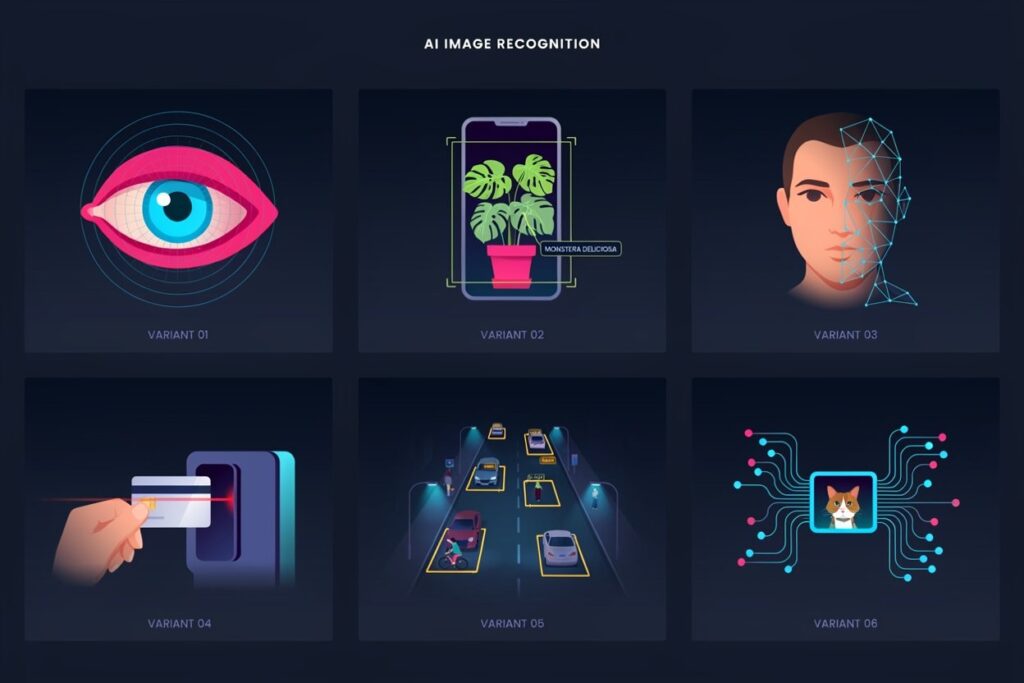
Computer vision is the field itself. Everything a machine does with visual input — capturing it, processing it, analyzing it, acting on it.
Image recognition is a task inside that field. It’s the part that answers “what is this a picture of.” A cat. A stop sign. A cracked pipe fitting.
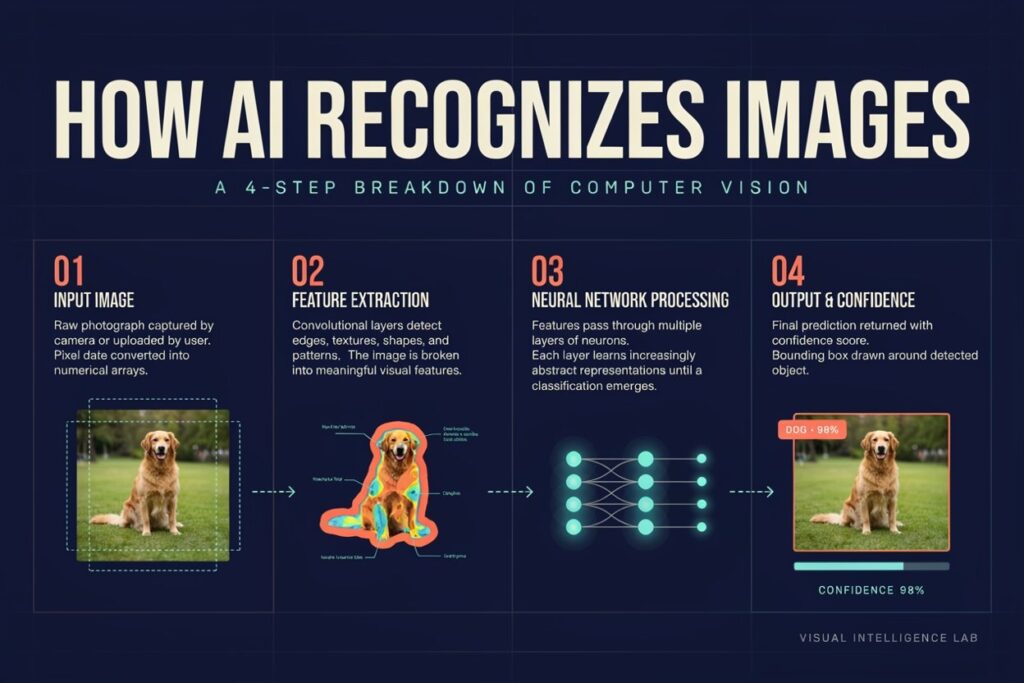
Image classification slaps one label on the whole picture. Object detection goes further — draws boxes around multiple items, names each one separately. Image segmentation goes further still. Semantic segmentation labels every single pixel by category; instance segmentation tells apart individual objects even when they’re overlapping, like two people standing shoulder to shoulder in a security frame.
Facial recognition is its own specialized branch — identifying or verifying a specific person from their face, usually starting with face detection and then matching against a stored embedding. It’s also the most heavily regulated corner of the whole field, and for good reason.
OCR technology is a related but genuinely separate discipline. It’s not asking “what object is this,” it’s asking “what’s written here.” Text extraction from images now often runs in the same pipeline as object detection, especially in retail and logistics, where a product label and the product itself both need reading.
The underlying mechanics haven’t really changed — it’s still pattern recognition running on neural networks — but the tools got noticeably sharper.
Convolutional neural networks still carry a lot of production systems. A CNN image recognition model scans an image in small patches, building layers of features — edges first, then shapes, then whole objects. Not unlike how a person’s eye catches an outline before it registers a face.
Vision transformers have taken over a big share of newer deployments though. Instead of scanning patches in sequence, a vision transformer treats the whole image as a set of tokens and weighs relationships between far-apart parts of the picture all at once. That’s a big reason deep learning image recognition handles cluttered scenes so much better now — a packed warehouse shelf, a busy intersection — than the CNN-only systems from a few years back.
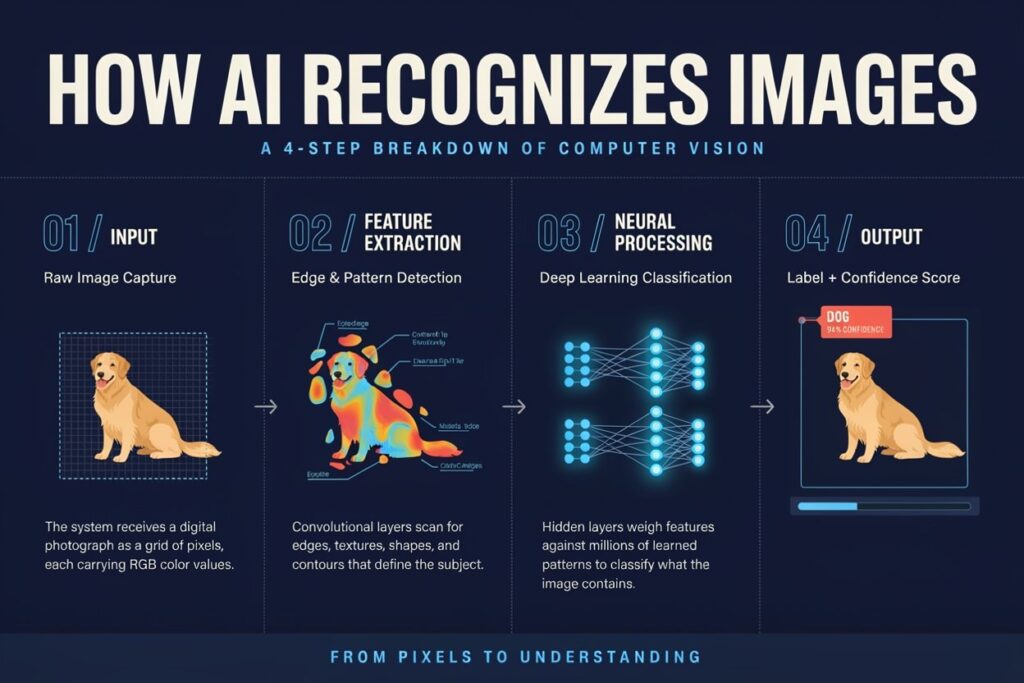
Model training still runs on a labelled image dataset. Thousands, sometimes millions, of tagged examples, occasionally padded out with synthetic training data to fill gaps the real world didn’t cover. Model accuracy gets measured against data the model’s never seen, and every single prediction comes stamped with a confidence score — which tells you how sure the model is. Not whether it’s right.
Two failure modes matter a lot here, and honestly, vendors don’t love bringing them up unprompted.
False positives — the model flags something that isn’t there. A smoke-detection camera that “sees” fire in ordinary kitchen steam.
False negatives — the model misses something that is there. A quality-inspection camera that waves a cracked part straight through.
Both cost real money. Which one you tolerate more of isn’t a technical decision, it’s a business one — a hospital reading scans wants close to zero false negatives even if that means more false alarms to sort through by hand.
If there’s one thing that changed artificial intelligence image recognition the most this year, it’s multimodal. Vision-language models don’t just slap a label on an image anymore — they reason about it, in plain language. Ask one whether a circuit board has a missing solder joint and it answers in a sentence, pointing at the exact region it’s talking about.
A few things this unlocked, that used to need custom-built pipelines for each one:
Visual question answering — open-ended questions about a picture instead of picking from a fixed list of labels.
Image captioning, automatic image description — useful for accessibility work, cataloging, content moderation at a scale no team could manually keep up with.
Visual grounding — the model points to the exact pixels backing up its answer. Matters a lot when someone needs to audit the decision later.
Zero-shot image classification — recognizing a category the model was never explicitly trained on, working purely off a text description.
Few-shot image recognition — teaching a model a brand-new object type from a handful of examples, not thousands.
Large vision models and foundation vision models — trained on huge, messy, varied datasets — are what make zero-shot and few-shot work at all in practice. A retailer can add a new product line to visual search without retraining from scratch now. Three years ago that was a multi-week project by itself.
Generative AI image recognition adds a strange twist to all this: the same tech that creates images is now getting used to catch them, which is basically how AI-generated image detection tools work under the hood.
Not every use case needs the same setup, and this is where a lot of projects quietly go wrong — cloud when latency ruins the whole experience, or on-device when the hardware just can’t keep up.
Real-time image recognition matters when a delay changes the outcome. A self-checkout camera catching a mis-scanned item before someone walks out the door. An assembly-line camera flagging a defect before the part moves any further down the belt.
On-device image recognition runs directly on a phone, camera, or edge chip. No trip to a server and back. Better for privacy, works with no connection at all, but limited by whatever memory and power budget that hardware actually has. Edge AI and mobile computer vision have both come far enough in 2026 that on-device models now handle work that used to require a cloud call, full stop.
Cloud-based image recognition and cloud vision API services trade some latency for a lot more raw compute. Useful for batch processing, heavier models, or keeping centralized control over a whole fleet of cameras spread across sites.
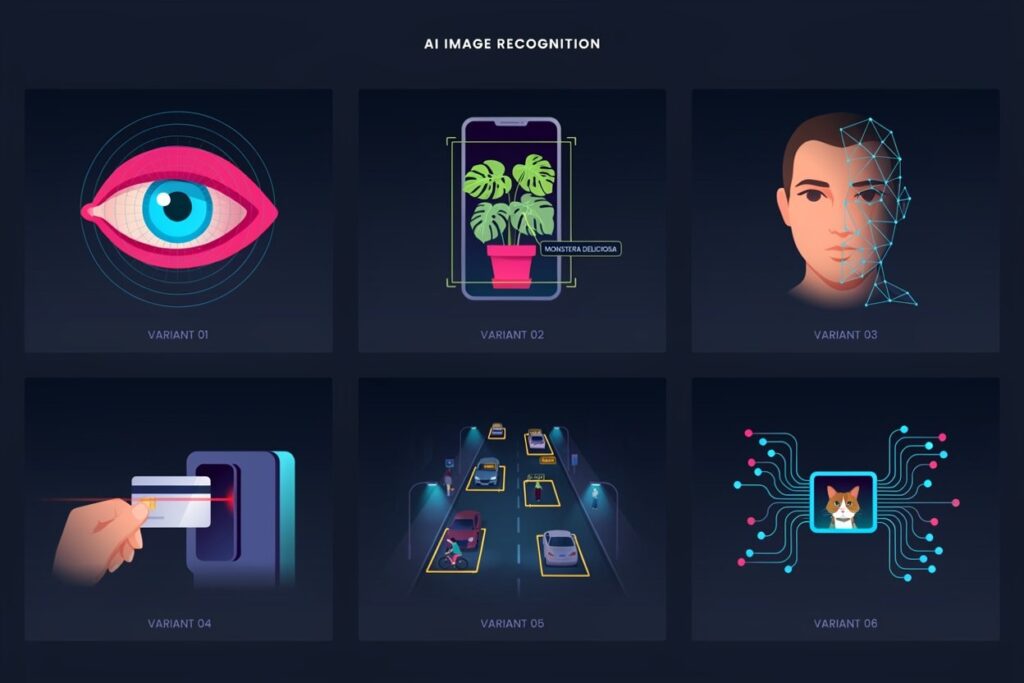
Most serious deployments this year end up hybrid, honestly. A lightweight on-device model makes the instant call, and a cloud vision API handles anything that needs deeper analysis or a human to look at it later.
| Industry | What It’s Used For | Where It Breaks Down Without Care |
| Healthcare computer vision | Medical image recognition, flagging anomalies in scans, tracking wound-healing photos over time | False negatives on rare conditions; models trained on data that skews non-diverse |
| Retail visual search | Reverse image search, product identification, ecommerce image recognition for “shop this look” | Inconsistent product photography — exactly the thing that hit Renata’s store |
| Manufacturing quality inspection | Catching cracks, misalignments, defects faster than a human eye on a moving line | Lighting shifts on the factory floor causing a spike in false positives |
| Security and surveillance | Smart surveillance, activity recognition, pattern recognition for anomaly detection | Facial recognition privacy violations when there’s no consent framework in place |
| Agricultural image recognition | Crop health monitoring, pest detection, yield estimates from drone footage | A model trained on one region’s crops failing badly on a different soil or light condition |
| Autonomous vehicle vision | Object tracking, object localisation, scene recognition for navigation calls | Edge cases nobody trained for — fog, glare, some obstacle nobody thought to include |
A real image recognition system in 2026 is usually several sub-technologies stitched together, even if most people lump it all under one word.
Feature extraction pulls out what’s distinguishing about an image before classification even starts. Image embeddings, vector embeddings, turn a picture into a list of numbers that can be compared mathematically — that’s the engine behind similarity search and visual search at any real scale. Pose estimation maps the position of a body or object, and it’s everywhere now, fitness apps, sports analytics, safety monitoring on a factory floor. Scene recognition identifies the overall setting — a kitchen, a highway, a hospital room — rather than picking out one single object. Image labelling and image tagging, still mostly done by humans checking a machine’s suggestions, remain the unglamorous, unavoidable work behind decent training image data. And visual content moderation scans uploaded images for policy violations before they ever go live, at a volume no human team on earth could review alone.
None of this is magic. Pretending otherwise is exactly how projects fail.
AI model bias shows up the moment training image data skews toward one demographic, one lighting setup, one camera angle — the model just performs worse on everything outside that pattern. Responsible AI practices, auditing datasets, testing across subgroups, writing down known limitations instead of hiding them, aren’t optional in regulated industries anymore. They weren’t really optional before either, but now someone’s actually checking.
Facial recognition privacy and biometric data protection rules vary state by state, and a system that’s fine in California won’t automatically clear Illinois’ stricter biometric consent laws. Get legal eyes on it before the cameras go live. Not after.
Image recognition security cuts two ways — protecting the system from being fooled by adversarial images built specifically to trick it, and protecting whatever data the system collects from being misused down the line.
The deepfake problem isn’t slowing down either. AI-generated image detection and content authenticity checks are becoming standard features across content platforms, newsrooms, even ecommerce sites just trying to keep fake product photos off their own listings.
| Question | Why It Matters |
| Is your training image data labelled consistently? | Inconsistent tagging is, by far, the most common cause of bad model accuracy |
| Do you actually need real-time object detection, or is batch fine? | Decides whether edge AI or a cloud vision API fits the budget you’ve got |
| Have you tested false positives and false negatives separately? | One accuracy number hides which kind of error your business can actually live with |
| Does this touch facial recognition or biometric data anywhere? | Triggers state-specific privacy and consent rules before you can launch |
| Can the model handle zero-shot or few-shot cases? | Determines how expensive adding new product lines gets later |
| Who reviews the low-confidence predictions? | Every image recognition system needs a human fallback for the edge cases |
Renata’s store got fixed, for what it’s worth. Not with a fancier off-the-shelf model — with a rebuilt image pipeline. Consistent photography standards, a catalog labelled properly for once, a visual search model trained on her actual inventory instead of some generic public dataset. Conversion on that widget went from 1.2% to just under 9% in ten weeks.
That’s the pattern behind almost every AI image recognition rollout that actually works. The model is rarely the hard part. The data discipline, the architecture choice, the way it gets wired into an existing product — that’s where it’s won or lost.
AsappStudio builds custom artificial intelligence solutions for businesses that need image recognition to hold up in production, not just look good in a demo. That includes computer vision built directly into mobile app development projects — on-device recognition for iOS and Android — visual search and product-matching for ecommerce development clients, and camera-based monitoring tied into IoT development work for manufacturing and agricultural clients. Every build runs through the same quality assurance process as the rest of our software development work, because a model that hits 94% in a test environment and never gets pressure-tested in the real world is really just a coin flip wearing a lab coat.
If you’re staring down a visual search feature, a quality-inspection camera, or a compliance headache around facial recognition — talk to us before you pick a vendor. Reach out here. It’s cheaper to get the architecture right the first time than to redo it later, the way Renata had to.
1. What is AI image recognition in 2026?
Technology that identifies objects, text, faces, or scenes in images through neural networks — increasingly powered by multimodal, vision-language models this year.
2. How accurate is AI image recognition in 2026?
Depends heavily on the task and the data. Well-trained models often clear 95%, but messy training data drags real-world results down fast.
3. Can AI detect AI-generated or fake images?
Yes — AI-generated image detection and deepfake detection tools compare pixel patterns and metadata, though accuracy keeps shifting as generators improve too.
4. What’s the difference between image recognition and object detection?
Image recognition labels the whole image. Object detection finds and labels several individual items inside it using bounding boxes.
5. Is on-device image recognition better than cloud-based?
Not universally. On-device wins on privacy and speed, cloud wins on heavier processing and central control. Most 2026 systems just use both.