
Marisol Fenwick was three sips into her coffee when the pager went off. It was 8:47 a.m. in Austin, Texas, and her logistics-tracking startup had just landed a feature in a regional business newsletter. Good news, in theory. Within eleven minutes, signups tripled. Within twenty, her app’s API response time crawled from 140 milliseconds to something closer to four full seconds. Then came the connection timeouts. Then came the support tickets.
Marisol wasn’t short on funding. She wasn’t short on engineers, either — six of them, sharp people, all staring at the same dashboard. What she was short on was a database that could handle the moment. Her single PostgreSQL instance, the one that had carried the company since its earliest days, was pinned at max CPU, its connection pool exhausted, its query queue backing up like rush hour on I-35.
This is not a rare story. It’s the story of nearly every growing application, somewhere between year two and year four, in every U.S. state from California to Connecticut. And it’s exactly why so many founders are searching for the same thing right now: how to scale a database in 2026, before the traffic spike finds them first.
This guide walks through what actually works — not theory for theory’s sake, but the real strategies, tools, and decisions that separate applications that survive their growth from ones that get buried by it.
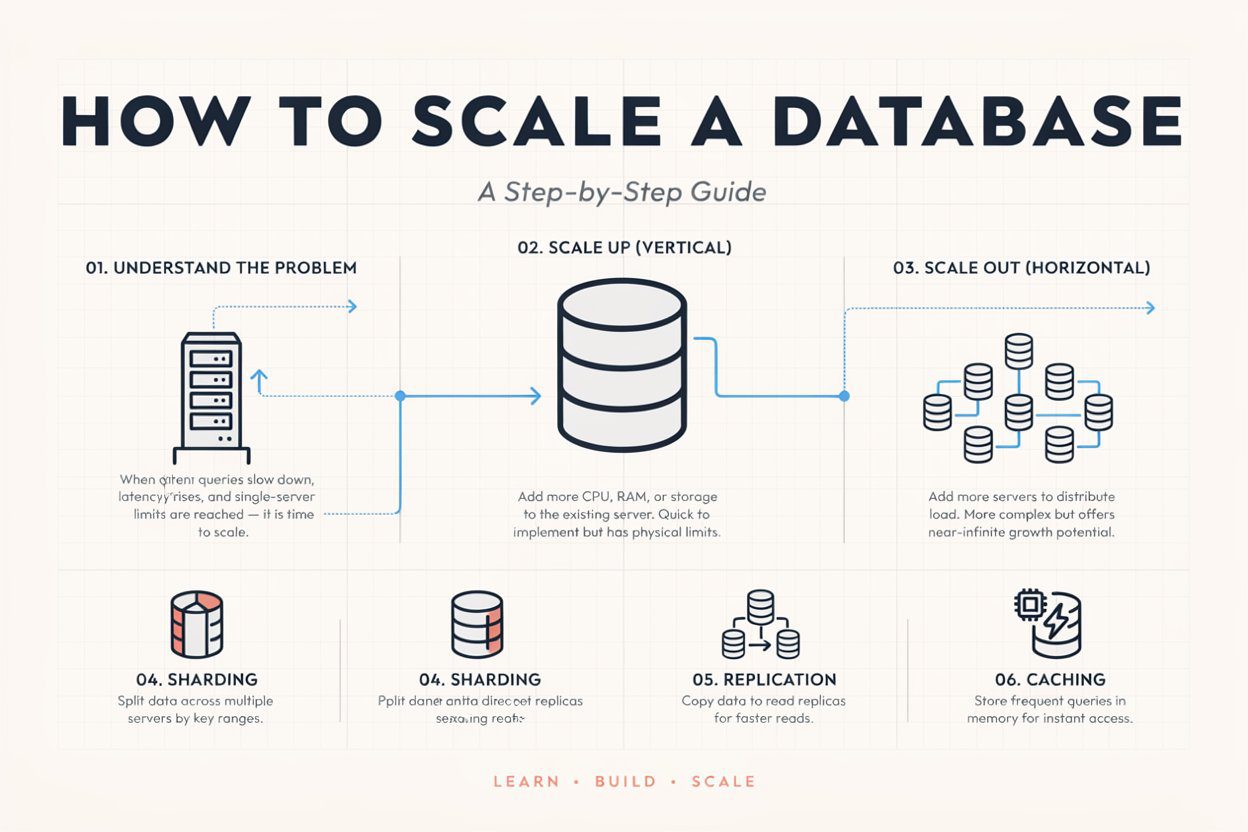
So — what is scaling in database terms, stripped of the jargon? It’s the ability of your data layer to keep performance steady as demand grows, whether that demand shows up as more users, more writes, more reads, or just messier, bigger data. Scalability in database systems isn’t a single feature you switch on. It’s an architecture decision, made up of dozens of smaller choices, each one buying you headroom.
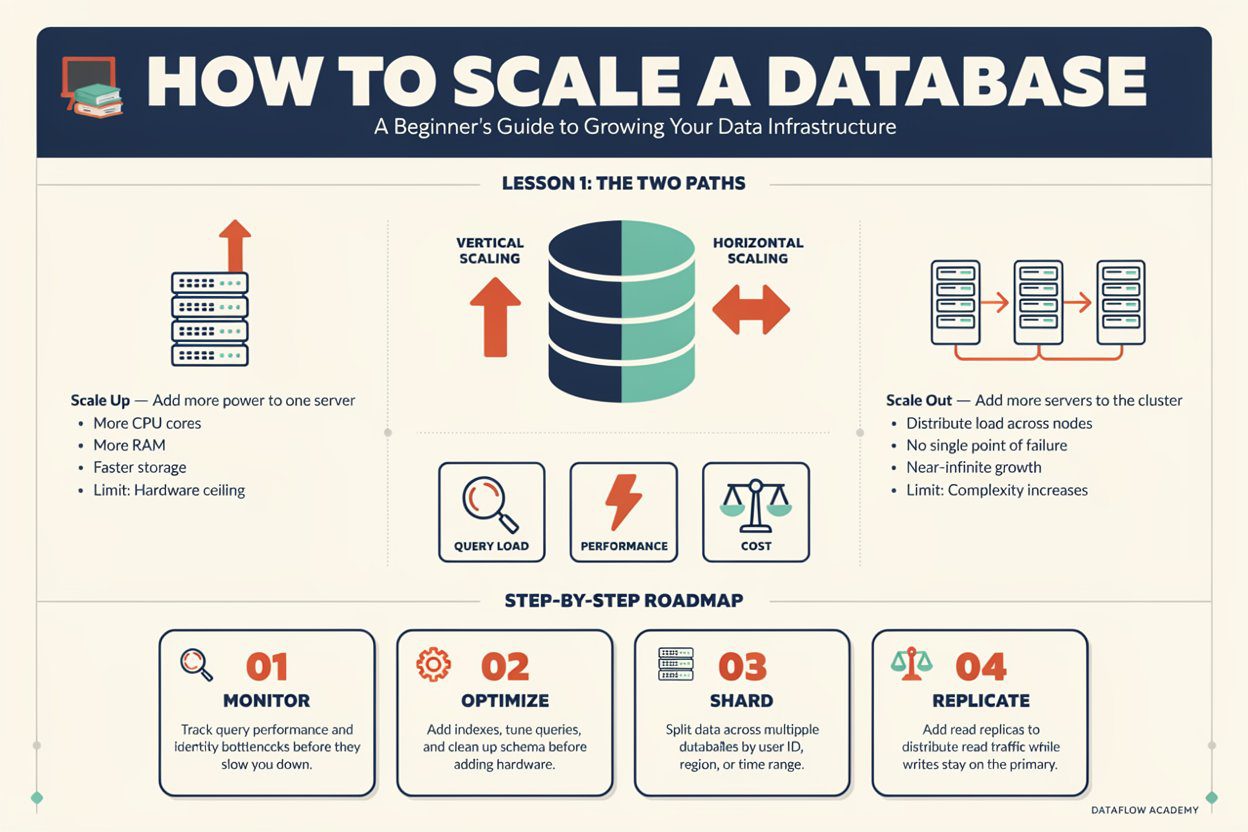
Database scalability tends to break down into two broad families of database scaling strategies: making one machine stronger, or spreading the work across many machines. Most serious database scaling guides — this one included — will tell you the real answer is almost always some blend of both, applied at the right time, to the right bottleneck.
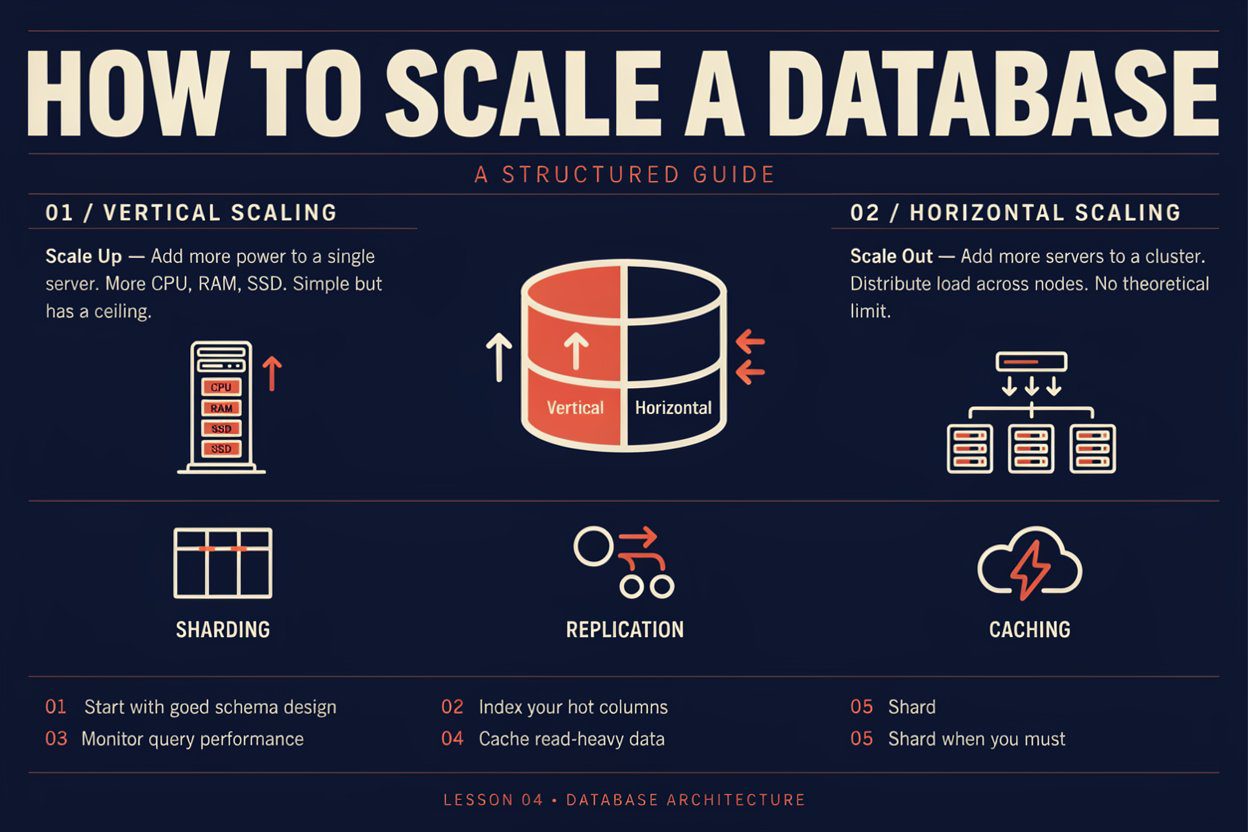
Vertical database scaling means giving your existing server more muscle. More CPU. More RAM. Faster storage with higher database storage IOPS. It’s the CPU and RAM upgrade path — simple, fast to execute, and often the right first move. Marisol’s team did exactly this in the first hour: bumped the instance size, watched query latency drop, bought themselves breathing room.
But vertical scaling has a ceiling. Eventually you’re paying enormous cloud bills for diminishing returns, and a single point of failure still haunts the whole system.
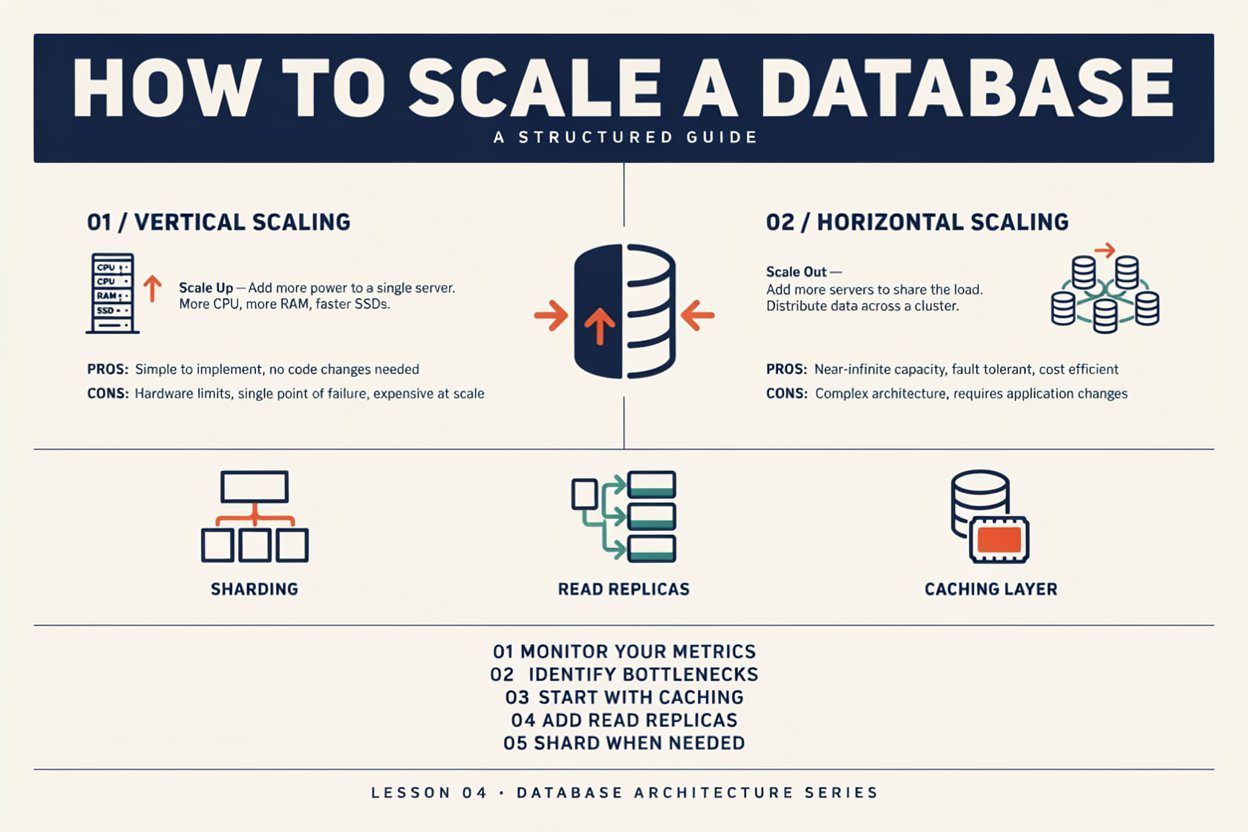
Horizontal database scaling takes the opposite approach — adding more database servers rather than upgrading one, and distributing load across them. This is the heart of the scale up vs scale out database debate. Database scale up buys time; database scale out buys durability. The best scalable database architecture usually starts with scale up, then transitions into scale out as growth becomes the norm rather than the exception.
When a single database, however powerful, can no longer hold your entire dataset comfortably, database sharding becomes the next serious conversation. Sharding splits your data across multiple independent databases, each holding a slice — a shard — of the whole.
The hardest part of sharding isn’t the infrastructure. It’s a shared key selection. Pick the wrong shard key and you’ll end up with hot shards — a handful of nodes doing all the work while the rest sit idle — plus painful cross shard queries that force your application to stitch together results from multiple databases at once.
Common approaches include hash based sharding, which distributes data evenly using a hash function; geographic sharding, useful for a multi-region database serving users across different time zones; and time based sharding, common in analytics-heavy systems. Application level sharding, where the routing logic lives in your app rather than the database engine, gives more control but adds real engineering overhead. Whichever path you choose, data locality — keeping related data physically close — matters enormously for distributed database scaling performance.
Database partitioning is often confused with sharding, but it’s a lighter-weight cousin. Table partitioning splits a large table into smaller, more manageable pieces within the same database instance, rather than across separate servers.
Range partitioning divides data by a continuous value, like order dates — useful for historical data archiving, where older partitions can be moved to cheaper storage without touching live traffic. Hash partitioning distributes rows evenly using a hash of the partition key, which helps avoid the uneven load that plain range partitioning can create. For most mid-sized applications, database partitioning is the first serious database scaling technique worth trying, well before sharding enters the conversation.
Database replication copies data from a primary database to one or more replica databases, and it’s arguably the single highest-leverage database scaling strategy for read-heavy workloads. Read replicas — sometimes just called a read only replica — absorb read traffic while the primary handles writes, which is the basic idea behind read-write splitting.
Two things engineers underestimate here. First, replication lag: the delay between a write landing on the primary and showing up on a replica. Second, the consistency trade-off it implies. Most replicated systems favor eventual consistency for read replicas, while write capacity stays centralized on the primary for strong consistency where it matters — payments, inventory counts, anything with real stakes.
Done well, this replication architecture also underpins high availability database design. Automatic failover promotes a replica to primary if the original fails, which is exactly what turns a potential outage into a five-second blip nobody notices.
If there’s one database performance optimization technique that pays for itself almost immediately, it’s caching. Database caching strategies sit between your application and your database, serving frequently requested data from memory instead of hitting disk every time.
Redis database caching and Memcached are the two workhorses here. The strategy you pick matters: cache aside strategy loads data into the cache only when it’s requested, write through caching updates the cache and database together, write behind caching writes to the cache first and syncs to the database later for speed, and read through caching lets the cache layer manage database reads transparently.
The trickier half of any caching layer is database cache invalidation — knowing when cached data has gone stale. TTL based caching expires entries automatically after a set time. Event driven cache invalidation clears specific keys the moment underlying data changes. Version based cache keys sidestep the problem entirely by baking a version number into the key itself, so old and new data simply live under different keys.
A surprising number of “database is slow” incidents are actually “database ran out of connections” incidents. Database connection pooling — tools like PgBouncer are the standard here — manages a shared pool of connections instead of letting every request open a fresh one, which keeps you under your database connection limits even when concurrent connections spike.
Beyond pooling, database query optimization and database indexing do more for real-world performance than almost any infrastructure change. Composite indexes, partial indexes, and covering indexes each solve a different flavor of slow query optimization problem — and unlike adding servers, they’re often free. Marisol’s team found two missing composite indexes that, once added, cut query execution time by more than half, no new hardware required.
Most teams in 2026 aren’t managing bare-metal database servers themselves — they’re leaning on managed cloud database platforms. AWS RDS and Aurora database scaling, Google Cloud SQL, and Azure SQL scaling all offer database autoscaling that adjusts capacity automatically as load changes, plus built-in read capacity and write capacity tuning.
Serverless databases take this further, scaling to zero during quiet periods and up during traffic spikes without manual intervention. For a growing application without a dedicated database infrastructure team, this cloud-native database approach is frequently the most practical database scaling architecture available — reliable database server infrastructure without the 2 a.m. pages.
SQL database scaling — think PostgreSQL scaling and MySQL scaling — has matured enormously, with mature replication, partitioning, and read replica tooling built in. PostgreSQL in particular has become the default choice for teams that want relational guarantees without sacrificing scalable database architecture options.
NoSQL database scaling takes a different philosophy. MongoDB scaling, DynamoDB, and Cassandra were built from the ground up for distributed databases and horizontal scaling, often trading some consistency guarantees for elastic database scaling and throughput. This is where the CAP theorem becomes more than an interview question: you genuinely cannot maximize consistency, availability, and partition tolerance all at once, so understanding which two your application needs shapes everything downstream, including whether ACID transactions or eventual consistency fits your use case.
Database observability — real monitoring of database throughput, database latency, database concurrency, and query throughput — is what turns database scaling from reactive firefighting into planned database capacity planning. Change data capture, or CDC architecture, streams database changes in real time, which is increasingly central to microservices database architecture and to keeping caches and search indexes in sync without manual polling.
Workload management and traffic distribution across a database cluster prevent the kind of hotspot prevention failures that took down Marisol’s single-instance setup in the first place. The goal isn’t a database that never has database bottlenecks — it’s one where bottlenecks show up on a dashboard hours before they show up as an outage.
| Area | Action | Why It Matters |
| Vertical scaling | Upgrade CPU, RAM, and storage IOPS | Fast, low-risk first response to load |
| Horizontal scaling | Add read replicas and plan for sharding | Removes single points of failure |
| Indexing | Add composite, partial, and covering indexes | Cuts slow query optimization work dramatically |
| Caching | Implement Redis or Memcached with clear invalidation rules | Reduces direct database load |
| Connection pooling | Deploy PgBouncer or equivalent | Prevents connection-limit outages |
| Partitioning | Apply range or hash partitioning to large tables | Keeps queries fast as tables grow |
| High availability | Configure automatic failover across replicas | Turns failures into non-events |
| Monitoring | Track latency, throughput, and replication lag | Enables capacity planning before crisis |
This is exactly the kind of problem AsappStudio’s software development team gets called in for — not to rebuild an application from scratch, but to re-architect the data layer underneath one that’s already working, just outgrowing itself. Our engineers have handled everything from sharding strategy for high-traffic platforms to designing failover-ready replication for clients who simply cannot afford downtime.
For companies running custom systems built on internal data — a custom ERP or custom CRM platform, for instance — database scaling decisions ripple through the entire product, and getting the architecture right the first time saves months of rework later. Our quality assurance team also load-tests these systems before launch, so bottlenecks get caught on a staging server, not during a customer’s biggest traffic day. And for teams that need extra database and backend engineering hands fast, our staff augmentation services plug experienced engineers directly into your existing team.
If your application is starting to feel the strain Marisol felt in Austin, reach out to AsappStudio before the next traffic spike makes the decision for you.
1. What is database scaling in simple terms?
It’s designing your database so performance stays steady as users, data, and traffic grow, using both hardware and architecture changes.
2. Should I scale vertically or horizontally first?
Start vertically for a quick fix, then move to horizontal scaling — replicas, sharding — once a single server hits its ceiling.
3. How many users can a single database handle?
It varies widely, but a well-tuned single instance often handles thousands of concurrent users before replicas or sharding become necessary.
4. Is database sharding always necessary for growth?
No. Many applications scale for years using replication, caching, and indexing alone before sharding is ever required.
5. Which database scales better, PostgreSQL or MongoDB?
Both scale well but differently — PostgreSQL suits relational, consistent data; MongoDB suits flexible, distributed, high-throughput workloads.