
My neighbor runs a 30-person accounting firm out of Scottsdale, Arizona. Smart guy. Pays his taxes, knows his margins. Two years ago he told me — and I’m quoting directly here — “we’re too small to get hacked.”
Last March, someone in his office clicked a link in what looked like a DocuSign email. By 11 a.m. that Tuesday, eight client files were sitting on a server in a country neither of us can locate on a map without Google. The attackers didn’t send a ransom note. They just waited. Sold the data quietly. His firm found out from a client whose identity had already been misused.
He had antivirus software. He had a firewall. He did not have cybersecurity monitoring.
That’s the gap we’re talking about in 2026. Not whether you have tools — but whether anything is actually watching.
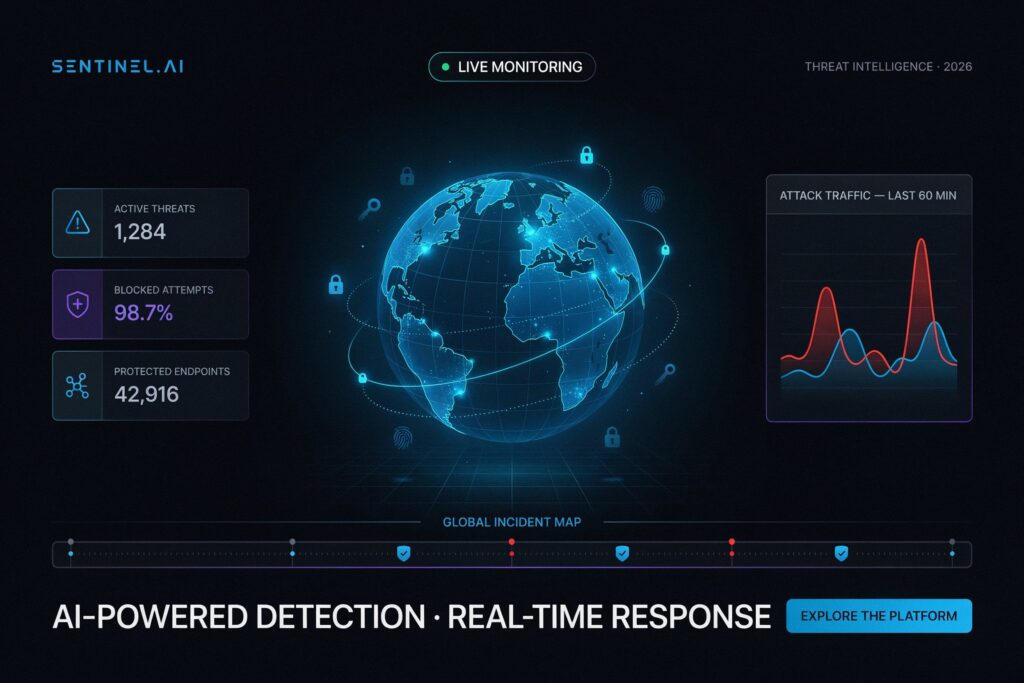
What is cybersecurity monitoring 2026? I’ll give you the plain version, not the vendor version.
It’s the practice of keeping eyes — human eyes, AI-assisted eyes, automated systems — on everything happening inside your digital environment. Networks, devices, cloud accounts, user logins, file access. All of it. All the time.
What is cybersecurity monitoring in 2026 specifically? It’s that same practice, except the threat volume has tripled, the attack methods have gotten smarter, and the environments being monitored have gotten a lot more complicated — because most U.S. businesses now run part of their infrastructure on-premise and part in the cloud, and the security tools protecting each half don’t always talk to each other.
Continuous cybersecurity monitoring means there’s no gap. No “we check alerts on Monday mornings.” No alert that sits unreviewed over a holiday weekend while an attacker moves through your file servers. 24/7 monitoring, real-time cybersecurity monitoring, active response — that’s what the phrase is supposed to mean when security vendors use it. Whether it actually means that at your company is a different question.
Here’s something that doesn’t get said enough: the majority of companies that get breached had security tools running at the time.
That’s not a comforting statistic. It means having a security monitoring platform isn’t the answer. Having one that’s properly configured, actively watched, and connected to a response process — that’s the answer.
A law firm in Nashville, Tennessee bought a midrange SIEM tool in 2023. It generated 4,000 alerts a week. Nobody had time to look at 4,000 alerts. So they looked at zero. The SIEM was running. The firm was blind.
Alert fatigue is one of the most documented and least-fixed problems in security operations. SIEM monitoring without SOAR tools to filter and automate — or without a SOC team that has the bandwidth to actually review — becomes an expensive checkbox rather than a real defense.
The companies getting security right aren’t necessarily the ones with the biggest budgets. They’re the ones that have matched their tools to their team’s actual capacity. And in 2026, for most small and mid-size businesses outside New York, San Francisco, or Chicago, that means leaning on managed cybersecurity monitoring services rather than trying to build everything in-house.
I want to skip the generic “cyber threats are evolving” language because you’ve read that before and it told you nothing. Here’s what’s actually happening.
Ransomware monitoring used to mean watching for encryption activity — the sudden mass-encryption of files that signals an active attack. That’s still relevant. But modern ransomware groups don’t start with encryption.
They spend weeks inside your network first. Moving slowly. Mapping file shares. Identifying your backup servers. Then they exfiltrate data — pull it out and store it on their infrastructure — before they ever touch your files. When the encryption finally runs, they’ve already got leverage: pay us, or we publish your client data on the dark web.
This means ransomware protection now requires monitoring for data exfiltration behavior, not just encryption events. And dark web monitoring — watching underground forums and leak sites for evidence that your data is being sold or threatened — has become a legitimate operational necessity, not a specialty service.
Phishing detection monitoring in 2026 covers three layers because a single phishing email often kicks off a multi-stage attack. First the email — filtered (hopefully) at the email gateway. Then the credential theft — the fake login page the email links to. Then the access — the attacker using the stolen credentials to log in through your VPN or Microsoft 365.
Phishing protection that only catches the email misses the second and third stage. Identity threat monitoring has to pick up what the email filter misses. If an account starts logging in from an IP it’s never used, at 3 a.m., and immediately starts downloading files — that’s the signal. That signal needs to fire and something needs to happen.
A few years ago, “network security monitoring” meant watching traffic on your on-premise network. That’s still necessary. But for most U.S. businesses with any cloud footprint — AWS, Azure, Google Cloud, or even just heavy use of SaaS tools like Salesforce and Slack — the cloud is now where the action is.
Cloud security monitoring watches your cloud-native resources: who’s accessing them, what configurations are drifting toward vulnerable states, what data is being moved where. Cloud security posture management (CSPM) specifically watches for the configuration mistakes that attackers exploit — S3 buckets accidentally made public service accounts with permissions far beyond what they need, API keys that have never been rotated.
Hybrid cloud security monitoring ties the on-premise and cloud views together. Without that unified view, you have two half-pictures instead of one complete one. Attackers know this. They specifically look for organizations where the cloud environment is monitored less carefully than the on-prem network.
Remote workforce security monitoring became a real thing during the pandemic years. The problem didn’t go away when some people came back to the office — because plenty didn’t come back, and even the ones who did still access systems from personal devices, home networks, coffee shops.
Insider threat detection isn’t about assuming your employees are criminals. It’s about recognizing that compromised employee credentials look identical to real employee behavior — until they don’t. User behavior analytics builds a baseline for what each user’s normal activity looks like. When something deviates sharply — bulk downloads, off-hours access, accessing files far outside their normal scope — an alert fires.
The same tooling that catches malicious insiders catches compromised accounts. One use case, two threat categories.
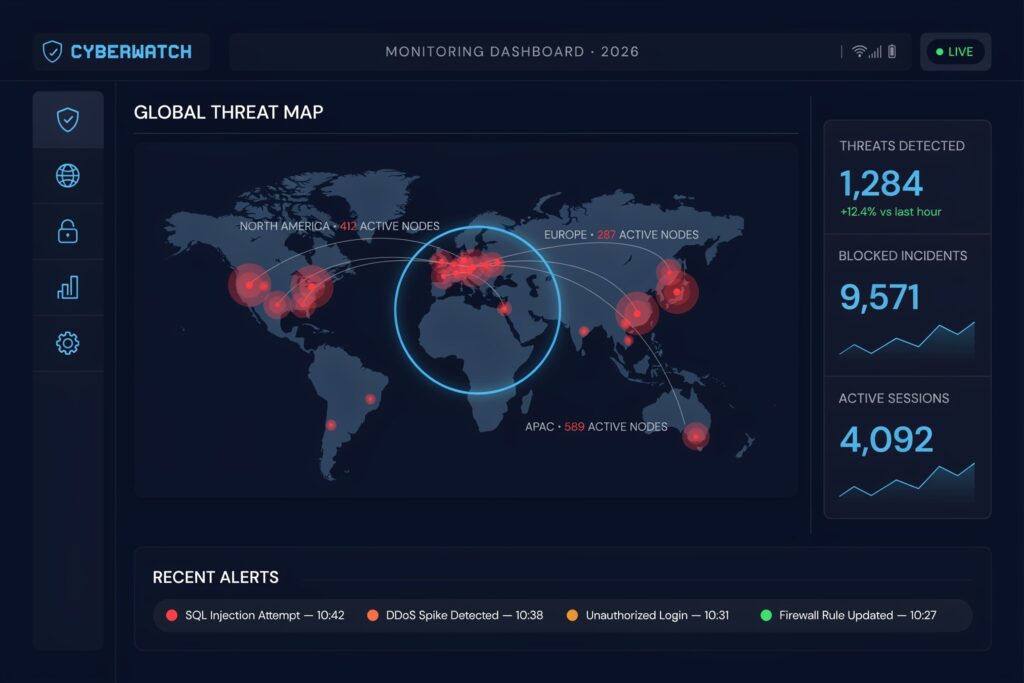
Let me walk through the core components without the marketing language.
This is the foundation. Network security monitoring tools watch what’s moving across your network — which systems are talking to which, what protocols are being used, whether traffic patterns match what you’d expect.
Network traffic analysis is how anomalies get spotted. A workstation that suddenly starts making outbound connections to an IP in a country you don’t do business with — that’s network traffic analysis catching something that signature-based tools would miss because the malware might be new and unrecognized.
Intrusion detection is the alerting layer — flagging when traffic matches known attack patterns or behavioral baselines get broken. Intrusion prevention goes a step further and blocks the traffic automatically rather than just alerting on it.
Security information and event management — SIEM — is the aggregation and correlation engine. It pulls log data from everywhere: your firewall, your servers, your cloud services, your applications, your identity provider. Then it runs correlation rules against that data to surface patterns that indicate something bad.
Log monitoring cybersecurity and security event monitoring both feed into SIEM. The quality of your SIEM output is directly proportional to the completeness of your log inputs. If your cloud workloads aren’t sending logs to your SIEM, the SIEM can’t see what’s happening there.
SOAR tools — Security Orchestration, Automation, and Response — are what make SIEM manageable at scale. Automated playbooks handle the high-volume, low-complexity alerts. An alert fires because a user failed login 5 times? SOAR automatically checks whether it’s the same user, from the same location, during business hours — and if so, probably closes it as a locked account rather than an attack. Your analyst’s time stays focused on the 12 alerts that actually need a human.
SIEM and SOAR monitoring together create the detection-response feedback loop that separates functional security operations from security theater.
Endpoint detection and response — EDR monitoring — watches individual devices. Not just for known malware signatures, but for behavior. A process that spawns unexpected child processes. Memory injection techniques. Fileless attacks that leave no artifacts on disk. EDR catches these by watching what processes are actually doing rather than comparing file hashes to a database of known threats.
XDR monitoring extends that view. An XDR platform correlates endpoint data with network logs, cloud activity, email signals, and identity data to build a picture of an attack across its full scope. Instead of seeing “suspicious process on Workstation 14,” you see “suspicious process on Workstation 14 that connected to a C2 server identified in network logs, using credentials that logged in from an unusual location 45 minutes earlier.” That’s actionable. The endpoint alert alone is a starting point.
Cloud threat monitoring watches your actual cloud-native infrastructure — compute instances, containers, serverless functions, databases. Cloud workload protection specifically covers the security of those workloads at runtime, catching attacks that occur after deployment.
This is different from cloud security posture management, which is more about configuration. Runtime protection catches an attack in progress. CSPM catches the misconfiguration that made the attack possible. You need both.
Identity and access monitoring tracks authentication events, privilege changes, MFA status, and access patterns across your identity providers — Active Directory, Okta, Azure AD, whatever you’re running. The reason this matters so much in 2026: most successful attacks involve compromised credentials at some point. An attacker who has a valid username and password looks like a legitimate user to your firewall.
Zero trust monitoring operationalizes the zero trust security principle. Rather than trusting anyone inside the network perimeter, zero trust assumes every user and device needs to be continuously verified. Zero trust monitoring provides the continuous verification layer — checking that each connection request meets the required trust criteria, and flagging when it doesn’t.
A Security Operations Center — SOC team of analysts running 24/7 monitoring, incident detection, and active response — is what enterprise cybersecurity actually looks like. A mature in-house SOC costs somewhere between $2M and $5M a year when you factor in staffing, tooling, training, and the brutal reality that experienced SOC analysts burn out and leave.
For most businesses in Memphis, Raleigh, Salt Lake City, or Columbus that aren’t Fortune 500 companies — that’s not a realistic path. Here are the realistic options:
SOC as a Service gives you a full SOC team on subscription. Security operations center monitoring runs 24/7. Your internal team escalates to them; they investigate and contain. You’re not staffing a night shift.
MDR Services — managed detection and response — go beyond monitoring. An MDR provider doesn’t just alert you; they investigate and actively respond to threats on your behalf. MDR services have become the dominant choice for mid-market businesses because they combine the tools, the team, and the response capability in one service. SOC monitoring services for growing businesses are increasingly delivered this way.
Managed Security Monitoring / Managed Security Services — monitoring and alerting, but response is your problem. Works if your internal team has real capacity to act on escalations quickly.
Which one fits depends on your internal capabilities, your risk profile, and your compliance obligations. But the honest answer for most small and mid-size businesses: MDR services or SOC as a service will serve you better than trying to stretch a two-person IT team across full-spectrum monitoring.
Build in-house if: you’re an enterprise with the budget, the regulatory pressure to keep data internal, and the ability to actually retain security talent long-term.
Use MDR if: you’re anything smaller than that. Managed detection and response services for businesses give you response capability that would cost 10x to replicate internally.
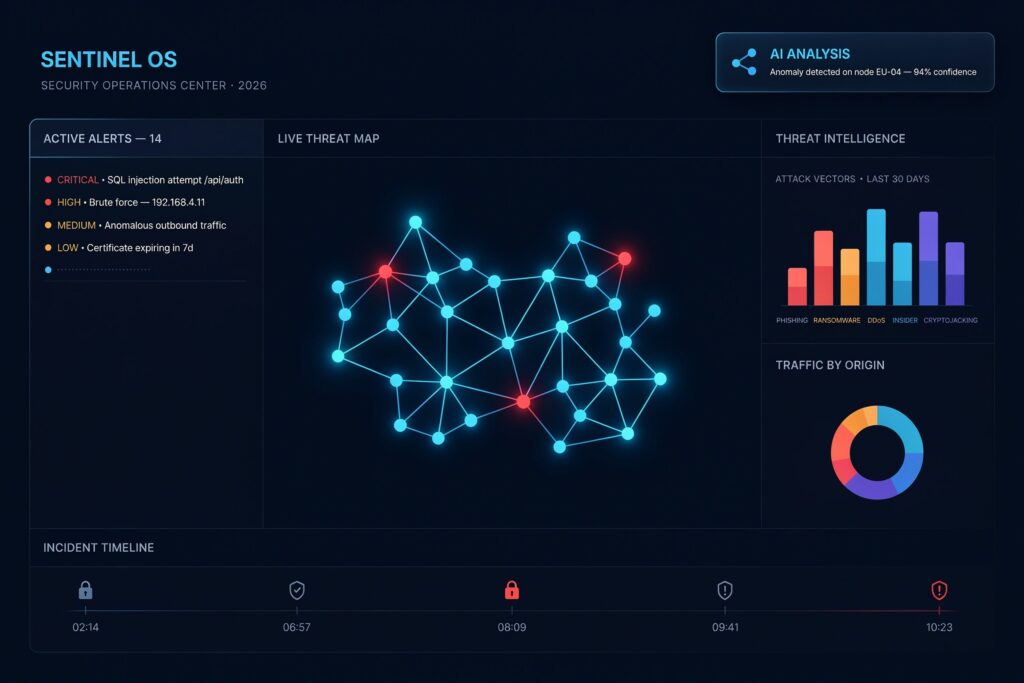
Every vendor claims AI. Here’s how to separate substance from noise.
AI-powered threat detection that actually works improves anomaly detection. Not just “traffic looks unusual” — but “this specific combination of behavioral signals across this user, this device, and this network path matches the pre-exfiltration pattern we’ve seen in 47 previous attacks.” Machine learning threat detection trained on real incident data gets legitimately good at this.
Automated threat detection reduces the window between compromise and detection. The industry benchmark for mean time to detect was historically measured in months. AI-assisted monitoring — when properly implemented — gets that number into hours or minutes for many attack types.
Automated security response closes the loop. When a SOAR platform connected to AI detection can automatically isolate a compromised endpoint, revoke a session token, block a suspicious IP, and create an incident ticket — all before a human analyst even opens their laptop — that’s real operational leverage.
What AI doesn’t fix: coverage gaps. If you don’t have cloud visibility, AI can’t see your cloud. If half your endpoints don’t have EDR monitoring, AI gets half the picture. AI security tools work on the data they receive. The monitoring coverage decisions you make determine what data they get.
Can AI detect cyber threats in real time? Yes — when the underlying monitoring infrastructure is complete. No — when it’s compensating for gaps in log collection, endpoint coverage, or cloud visibility.
This is where businesses in regulated industries in states like California, New York, Florida, and Texas have to get specific.
NIST Cybersecurity Framework includes continuous monitoring as a core function. Not optional. The framework’s “Detect” function is specifically about security continuous monitoring — identifying events that could indicate attacks in a timely manner. Cybersecurity monitoring best practices 2026 for federal contractors and NIST-aligned organizations require documented monitoring processes, regular review cycles, and demonstrated incident detection capability.
ISO 27001 Monitoring requirements under Annex A include security event logging, monitoring system use, and protection of log information. ISO 27001 certification audits expect to see evidence of ongoing monitoring, not just a monitoring policy document.
HIPAA for healthcare businesses — hospitals, practices, health tech companies, insurers — requires audit controls specifically designed to detect inappropriate access to electronic protected health information. Security event monitoring for ePHI access isn’t a recommendation; it’s a compliance requirement.
PCI DSS for any business processing credit cards requires network security monitoring, IDS/IPS coverage, daily log review, and quarterly network scans. Cybersecurity compliance under PCI includes documented log management processes with specific retention requirements.
SOC 2 for technology and SaaS companies requires continuous monitoring controls as part of the availability, security, and confidentiality trust service criteria. Auditors will ask for evidence. “We have a SIEM” without evidence of alerts reviewed and incidents responded to doesn’t satisfy SOC 2.
Compliance monitoring cybersecurity is ultimately about producing evidence — logs reviewed, alerts acted on, incidents documented, controls tested. Security compliance starts with monitoring but it ends with the paper trail that proves monitoring is functioning.
Not a templated list. Specific things that show up as gaps after real incidents.
How often should cybersecurity monitoring be done?
Continuously. Not daily, not weekly. The answer is continuous. Real-time cybersecurity monitoring means events are reviewed as they happen or within minutes. Anything less than that — and you’re accepting that attackers can move freely inside your environment for the gap period.
What should a cybersecurity monitoring system include?
At minimum: endpoint security monitoring (EDR) across all devices, network security monitoring tools watching traffic, SIEM tools aggregating and correlating logs from all critical sources, cloud security monitoring for any cloud workloads, identity and access monitoring for all user accounts, and a response process that actually runs when alerts fire.
What are common cybersecurity monitoring mistakes?
Buying tools and not tuning them. Running SIEM with default correlation rules from 2021. Having EDR monitoring on 80% of endpoints and not knowing which 20% are uncovered. Treating log management as an archive function rather than an active security input. Not testing whether your detection would actually catch the attack types most likely to target your industry.
How do companies monitor cyber threats?
Large enterprises: dedicated SOC team running 24/7, multiple SIEM and XDR platform tools, threat hunting exercises, and incident response teams on retainer. Mid-market: SOC as a service or MDR provider handling monitoring and response, with internal IT liaising on escalations. Small businesses: managed cybersecurity monitoring service covering endpoints, cloud, and email — monitored by the provider, with escalation to the business owner when real threats are detected.
How do small businesses monitor cybersecurity?
The honest path: partner with an MDR provider or managed security monitoring service. Small business cybersecurity monitoring doesn’t require a six-figure security team. It requires picking a provider whose coverage matches your environment, understanding what they will and won’t respond to, and ensuring you have a contact when something serious happens.
Security monitoring tools watch your environment. But the environment they’re watching — the applications, the infrastructure, the integrations — was built by someone. How it was built determines how much the monitoring layer has to compensate for.
Applications built with security as an afterthought have more attack surface. More exposed APIs. More overpermissioned database connections. More unvalidated inputs that become injection vulnerabilities. Every one of those is something your cyber threat monitoring has to catch and cover.
Applications built with security considerations from the start have smaller attack surfaces. Less for attackers to exploit. Less for monitoring to compensate for.
That’s the connection between Asapp Studio’s software development services and your security posture. We’re not a cybersecurity monitoring vendor. We’re the team that builds the software infrastructure your monitoring tools are watching over.
Our AI development services help businesses build intelligent systems — including internal tooling for anomaly detection, automated alerting, and security workflow automation. Companies using our IoT development services get connected device infrastructure built with endpoint visibility in mind — a significant gap in most enterprise security stacks because IoT devices are often the least-monitored assets.
For ecommerce businesses managing payment data — subject to PCI DSS compliance monitoring requirements — our ecommerce development team builds with payment security architecture in mind. For SaaS companies facing SOC 2 audits, our web development services and mobile app development approach security requirements as architecture decisions, not patches.
Businesses that need specialized security-aware development talent without committing to full-time hires use our staff augmentation services — particularly common for companies in growing tech markets in states like Colorado, Virginia, and Washington that are scaling fast and can’t build every capability internally.
If you want to understand how your current software architecture affects your security monitoring overhead — or how better-built systems reduce the attack surface your monitoring has to cover — reach out and let’s talk.

Ask these specific questions before you sign anything.
What is your mean time to detect and mean time to respond? If they can’t quote specific numbers from their customer base, they haven’t measured it. Walk away.
What does your coverage actually include? Get this in writing. Endpoints — how many, which OS types? Cloud — which providers, which services? Identity monitoring — which identity providers? Network — on-prem only or cloud network traffic too? The gaps in what they cover are the gaps attackers will find.
What SIEM tools and XDR platform do you use? You don’t need to be a technologist to ask this. But you do need to know whether their tooling can integrate with what you already have. SIEM and SOAR monitoring capability varies enormously between providers.
Who calls me at 2 a.m. when something real happens? Escalation path. Communication SLA during active incidents. Named contacts. If the answer is vague, the reality will be vague too.
How do you support my compliance requirements? Can they produce reports in the format your NIST cybersecurity framework or ISO 27001 monitoring audit requires? Do they document incident response actions in a way your compliance team can use?
What threat intelligence do you use? Are they feeding current threat intelligence into their detection rules? A provider whose correlation logic hasn’t been updated since last year will miss attack techniques that are actively being used today.
What is the best cybersecurity monitoring software?
There isn’t one. There’s the right stack for your environment. Enterprise: CrowdStrike, Splunk, Microsoft Sentinel, Palo Alto Cortex XDR are common. Mid-market and SMB: managed platforms from MDR providers usually beat self-managed best-of-breed tools because the management overhead of best-of-breed is real.
What are the best cybersecurity monitoring tools for businesses in 2026?
XDR platforms that correlate endpoint, network, cloud, and identity data in a single view. SIEM tools with strong automation and SOAR integration. EDR monitoring tools with behavioral detection (not just signatures). Cloud security posture management for cloud-heavy environments. And MDR services that wrap all of this in managed operations for businesses that can’t staff the monitoring internally.
What are the signs of a cyber attack?
Unusual authentication events — logins from new locations, failed MFA attempts in volume, new devices being enrolled. Anomalous network traffic — unexpected outbound connections, high data volumes moving to external IPs. Abnormal process behavior on endpoints — unexpected scripts running, new services being installed. User behavior anomalies — access to files or systems far outside normal patterns. These are what real-time cybersecurity monitoring is watching for.
Cybersecurity monitoring checklist for 2026:
Endpoint security monitoring covering 100% of managed devices. Cloud security monitoring across all cloud environments. Network security monitoring tools with network traffic analysis running continuously. SIEM tools aggregating logs from all critical sources. SOAR tools automating alert triage. Identity threat monitoring integrated with your identity provider. Zero trust monitoring for all remote access. Ransomware monitoring including behavioral detection and dark web monitoring. Phishing detection monitoring across email, endpoint, and identity layers. Documented incident response runbooks that your team has actually rehearsed. Compliance monitoring cybersecurity reporting aligned to your applicable frameworks. Regular vulnerability monitoring and threat hunting cadence.
How can cybersecurity monitoring prevent ransomware?
By catching the pre-ransomware activity that happens before encryption runs. Attackers spend time in networks before deploying ransomware. Network threat detection, user behavior analytics, and endpoint security monitoring all have opportunities to catch the reconnaissance, lateral movement, and data staging behavior that precedes the ransomware payload. Catching it at those earlier stages stops the attack before it becomes a recovery crisis.
What cybersecurity monitoring trends should businesses watch in 2026?
AI cybersecurity monitoring becoming baseline — not differentiator, baseline. Identity threat monitoring overtakes network-centric security as the primary focus. MDR services displacing traditional managed security services for mid-market. State-level compliance monitoring cybersecurity requirements expanding and diverging. Remote workforce security monitoring becomes permanent infrastructure, not a temporary pandemic response.
You read this far, which means you’re taking this seriously. Here’s the most direct thing I can say:
Cybersecurity monitoring 2026 is not a product you buy and forget. It’s not a checkbox on a compliance form. It’s an operational capability — continuous, active, connected to response, and tested against the actual threat scenarios your industry faces.
The Scottsdale accounting firm I mentioned at the start? My neighbor rebuilt after that breach. His firm now uses a managed cybersecurity monitoring service that covers every employee device, their cloud storage, and their email environment. He pays less per month than he spent on the breach recovery in a single week.
The math eventually becomes obvious. The only question is whether it becomes obvious before or after something bad happens.
Q1: What is cybersecurity monitoring 2026 and why does it matter for U.S. businesses? It’s real-time, AI-assisted watching of networks, endpoints, cloud, and identities 24/7. In 2026, threats move fast—monitoring is how businesses catch attacks before damage is done.
Q2: How do small businesses afford 24/7 cybersecurity monitoring?
MDR services and SOC as a service make it affordable—typically $1,000–$5,000/month, far less than breach recovery costs or hiring in-house SOC analysts full-time.
Q3: What is the difference between SIEM and SOC monitoring?
SIEM tools collect and correlate security logs to surface threat alerts. SOC monitoring is the human-and-process layer that reviews those alerts and drives incident response actions.
Q4: How does AI improve cybersecurity monitoring in 2026?
AI-powered threat detection cuts alert noise, catches behavioral anomalies signature tools miss, and enables automated security response—reducing detection time from days to minutes.
Q5: Is continuous cybersecurity monitoring required for compliance?
Yes. NIST, ISO 27001, HIPAA, PCI DSS, and SOC 2 all require documented, ongoing security monitoring—not just annual assessments or point-in-time vulnerability scans.