
Rachel Ferris didn’t think much about headless commerce in 2026 until the week her Shopify theme developer told her, flatly, that her homepage couldn’t do what she wanted. Rachel runs a mid-market home goods brand out of Austin, Texas. She wanted a shoppable Instagram feed, a wholesale portal for retail buyers, and a homepage that changed depending on whether a visitor arrived from a TikTok ad or a plain Google search. Her platform wasn’t built for any of it. Nothing had “broken,” exactly — the store just couldn’t stretch that far.
That’s the story playing out at ecommerce brands across the country right now — in Charlotte, in Denver, in a hundred smaller cities you’ve never heard of. Businesses are moving fast on AI product discovery, generative search, social checkouts, and omnichannel selling because the upside is real: faster storefronts, better personalization, more revenue per visit. But most traditional ecommerce platforms were never built to stretch that far, and that gap is exactly why headless commerce in 2026 has moved from a niche enterprise strategy to a mainstream replatforming conversation.
This guide breaks down what headless commerce in 2026 actually means, how it works under the hood, which platforms and CMS options are worth considering, what it costs, and what it really does to your SEO.
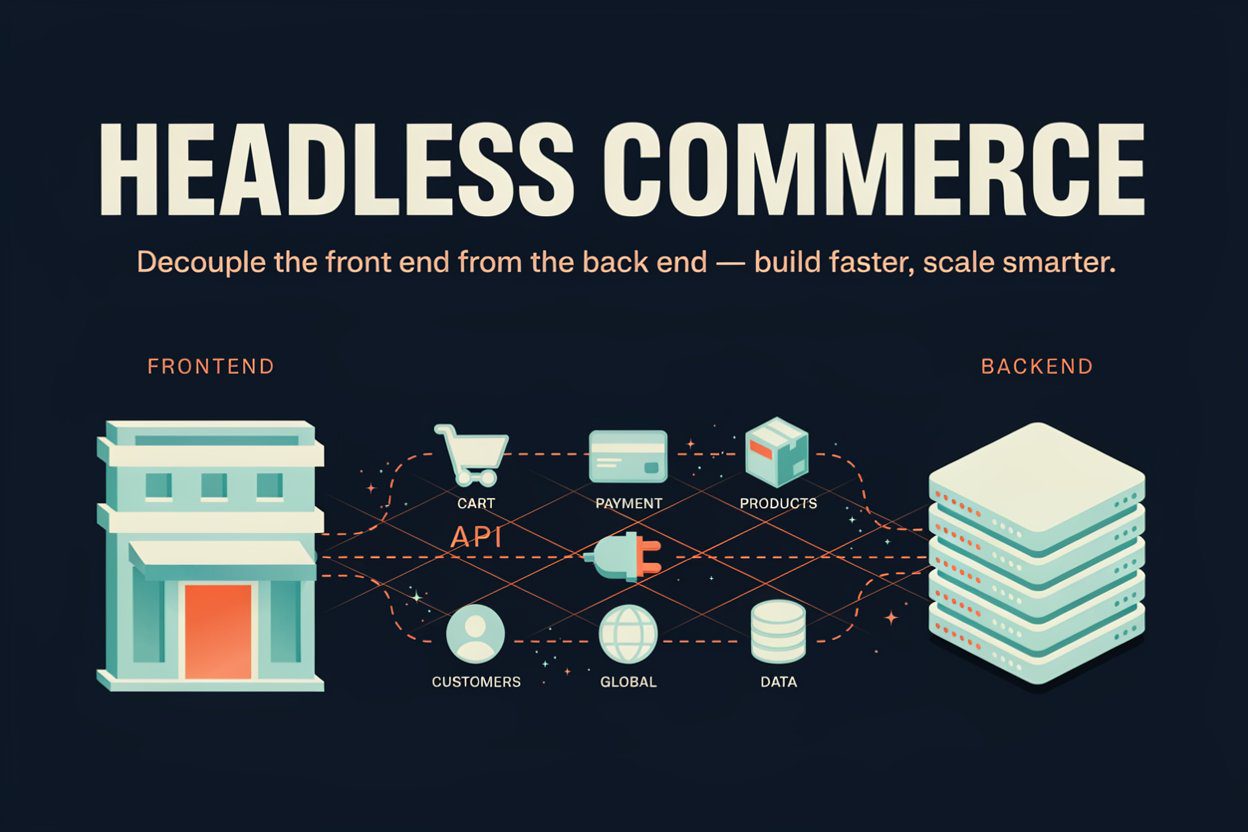
Strip away the buzzwords, and headless commerce is a setup where the frontend — what shoppers actually see and click through — is fully disconnected from the backend commerce engine that manages products, orders, and payments.
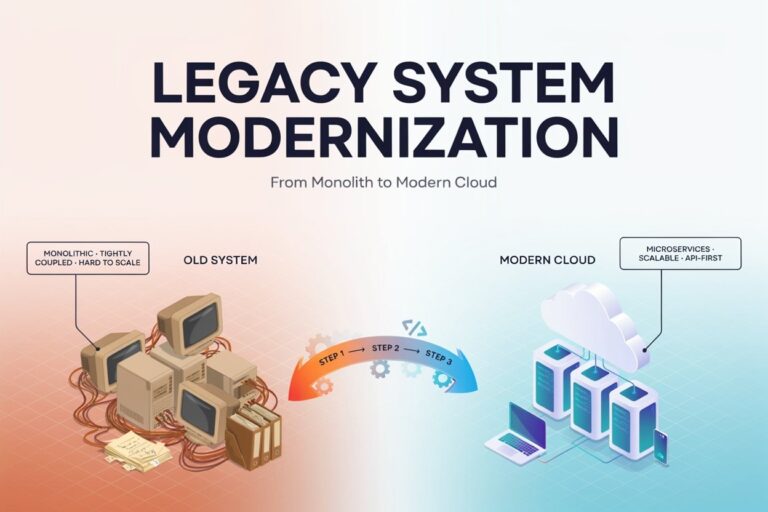
It’s not the same thing as a redesign, and it’s not the same as switching themes either. A traditional ecommerce build bundles storefront design, checkout logic, and the product database into a single system. Touch one piece and something else downstream can quietly break. Headless ecommerce architecture doesn’t work that way. The presentation layer — a website, an app, maybe a kiosk in a physical store — talks to the backend commerce engine through APIs instead of sitting directly on top of it.
Think of it like a restaurant kitchen. The kitchen cooks the food regardless of where it ends up — dining room, delivery bag, food truck window three blocks away. Front-of-house can change entirely and the kitchen never has to care. That’s a decoupled frontend in a sentence: the presentation layer runs on its own clock, separate from the API-driven backend underneath it.
For any ecommerce brand planning a custom storefront — a DTC company launching its first mobile app, or an enterprise retailer rolling out multiple regional sites — headless commerce in 2026 has to be part of the architecture plan from day one, not something bolted on after a launch.
Rachel’s problem wasn’t really about design. It was about flexibility, and that’s the part that kept costing her sales.
Here’s what’s actually at stake when an ecommerce brand outgrows a templated platform:
None of this requires a catastrophic platform failure. Most of it just requires a growing brand and a platform that was never designed to grow with it — which is exactly why headless commerce keeps coming up in replatforming conversations this year.
A headless commerce stack isn’t one product. It’s a collection of specialized systems, each handling one job, wired together through APIs.
Start with the frontend framework — usually Next.js, React, or a PWA storefront — which renders whatever the shopper sees. Most teams lean on server-side rendering or static generation here, partly for speed, partly so search engines can crawl the content without extra effort.
Behind that sits the backend commerce engine: product catalog, pricing, checkout, payments. Could be commercetools. Could be BigCommerce. Could be Adobe Commerce running headless, depending entirely on what the business needs.
Then the supporting systems. A CMS handles blog content, landing pages, and marketing copy separately from product data, often paired with a DXP for personalized delivery. A PIM centralizes richer product data before it reaches the storefront. An OMS tracks orders once a purchase happens, no matter which channel it came through. ERP and CRM tools tie commerce data back to finance and customer relationships, while a WMS keeps inventory management synced with the warehouse floor.
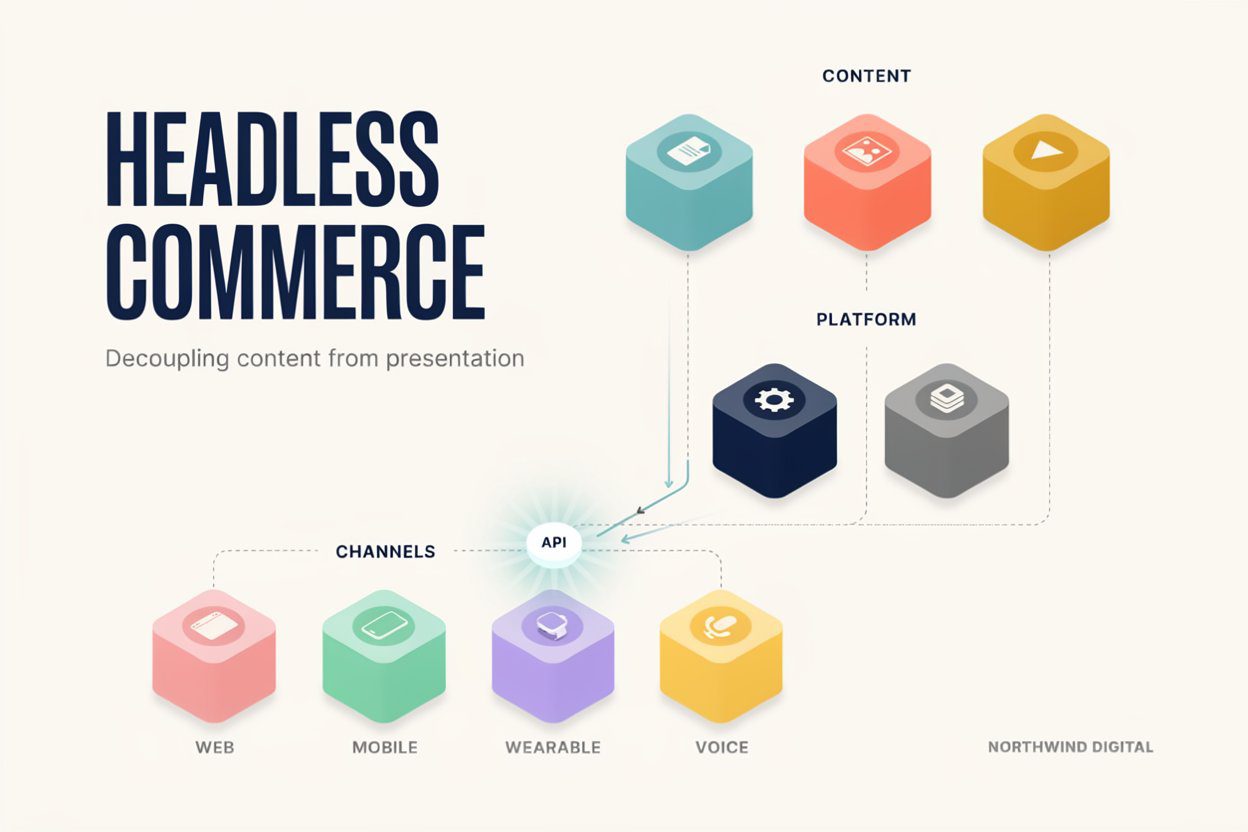
Search typically runs through something like Algolia. A personalization engine paired with a customer data platform drives tailored recommendations. Payments flow through providers like Stripe, connected via dedicated APIs rather than hard-coded into the storefront.
Every one of these pieces is a microservice inside a larger modular ecommerce stack. No single vendor owns the whole experience — the business is assembling a composable tech stack built for cloud-native commerce, with API reliability holding it together.
Most brands answer the headless commerce vs traditional ecommerce question by weighing how much control and speed they need against how much complexity they’re willing to carry.
| Factor | Traditional Ecommerce | Headless Commerce |
| Flexibility | Limited to theme/template structure | Full control over frontend design |
| Speed & Performance | Depends on platform, often slower on mobile | Optimized via SSR/static generation, better Core Web Vitals |
| Initial Cost | Lower, faster to launch | Higher upfront investment |
| Customization | Restricted by platform architecture | Nearly unlimited with custom development |
| SEO Control | Built-in but rigid | More flexible, but requires technical setup |
| Scalability | Can hit platform ceilings | Built for growth across channels |
| Developer Needs | Minimal to moderate | Requires ongoing developer resources |
| Omnichannel Support | Often bolted on | Native, since one backend feeds many frontends |
Neither wins outright. A standard Shopify or WooCommerce store gets a small catalog live in days, and for plenty of businesses that’s the right trade. Headless takes longer and costs more up front — but the ceiling disappears once a brand has outgrown templated design.
People use these two terms interchangeably. They’re not quite the same. Composable commerce vs headless commerce comes down to scope.
Headless commerce means one specific thing: decoupling frontend from backend.
Composable commerce takes that same “best tool for the job” logic and stretches it across the entire stack — search, CMS, payments, PIM, personalization — assembling independent, swappable services instead of leaning on one vendor’s bundled suite. Most composable builds follow MACH architecture ecommerce principles: Microservices, API-first, Cloud-native, Headless.
So every composable stack is headless. Not every headless build is composable. A brand can go headless on the frontend and still lean on a single vendor for most of the backend — headless, technically, just not composable in the strict sense.
Nobody sells this part in the pitch meeting. Headless commerce in 2026 is not a free upgrade, and it comes with real trade-offs worth understanding before signing a contract.
Custom frontend development, backend configuration, and integration work add up fast next to spinning up a templated store. A realistic mid-market build runs somewhere between $50,000 and $250,000, occasionally more depending on scope. Enterprise implementations often go well past that.
Ongoing developer resources become a requirement for changes a marketing manager used to make solo through a theme editor. This is one of the most underestimated costs of going headless.
More moving parts means more places for something to quietly break. API reliability stops being an abstract line item and becomes something a real person on the team has to own day to day.
CMS, PIM, OMS, and storefront all need to keep working together as each system updates on its own schedule. Someone has to own that coordination long after launch.
Rush the migration and a brand can end up with a stack that’s more fragile, and harder to fix, than whatever it replaced. Poor documentation during migration is one of the most common root causes of long-term technical debt.
Hiring a partner without genuine headless experience is one of the most common reasons these projects blow past budget, sometimes by a wide margin.
Marcus Deloitte leads ecommerce for a multi-brand apparel company based in Charlotte, North Carolina — no relation to the accounting firm, a joke he’s made more times than he’d probably like to admit. When his team evaluated headless commerce platforms, the decision came down to which backend fit their existing tech investments, not whichever vendor had the flashiest case study.
| Platform | Best For | Notes |
| BigCommerce (headless) | Mid-market to enterprise brands wanting flexibility without a full custom backend build | Strong native APIs, works well with Next.js storefronts |
| Shopify Plus + Hydrogen | Shopify-native brands wanting a custom frontend | Shopify Hydrogen is Shopify’s own React-based framework for headless storefronts |
| Adobe Commerce (headless) | Enterprise brands needing deep B2B and B2B2C functionality | Powerful, demands significant technical resources |
| commercetools | Brands wanting a fully composable, API-first backend | Popular in MACH-native builds; steeper learning curve |
| Salesforce Commerce Cloud | Enterprise retailers already inside the Salesforce ecosystem | Strong CRM and personalization tie-ins |
| SAP Commerce Cloud | Large B2B operations and complex global businesses | Deep ERP integration, best suited to SAP-native organizations |
For most growing DTC and mid-market brands, BigCommerce headless commerce and Shopify headless builds using Hydrogen offer the better balance of flexibility and manageable complexity. Larger enterprises with messier catalogs or global operations tend to land on commercetools headless commerce or Adobe Commerce headless instead.
Content — landing pages, blog posts, buying guides — stays separate from product data with the right headless CMS ecommerce choice, and that’s what frees a marketing team to publish without waiting on developers.
| CMS | Best For | Strengths |
| Contentful | Enterprise content teams | Mature API, strong localization support for multilingual storefronts |
| Prismic | Marketing teams wanting a friendly editor | Fast setup, suited to smaller content teams |
| Strapi | Developer-controlled, self-hosted setups | Open-source, highly customizable |
| Payload | Teams wanting code-first flexibility | TypeScript-native, popular with Next.js storefronts |
| Optimizely | Brands prioritizing personalization and experimentation | Strong A/B testing and DXP capabilities |
Small, marketing-led teams tend to move faster with Prismic or Contentful. Teams with in-house developers who want full control over how data is modeled usually land on Strapi or Payload as their best headless CMS for ecommerce.
Not every brand needs an in-house dev team to make this jump — this is exactly where the right agency partner earns its fee. When evaluating headless commerce agencies, look past the pitch deck and check specifics.
Have they shipped headless storefronts in your industry, or something close to your catalog size?
Real experience with whatever backend you’ve chosen — BigCommerce, Shopify Hydrogen, commercetools — not a general familiarity picked up from a sales deck.
This is where a lot of otherwise-strong dev agencies quietly fall short. Ask specifically how they handle server-side rendering, structured data, and canonical tags.
Replatforming from a legacy system is a different skill than building a greenfield. Confirm what support actually looks like once the launch party is over — headless stacks need maintenance for years, not weeks.
A handful of ecommerce trends 2026 are pushing more brands toward flexible architecture, each raising the stakes in its own way.
AI in ecommerce leads that list. AI product discovery and AI recommendations now mean shoppers expect search results that feel personalized, not generic. Agentic AI adds another layer: AI agents completing purchases on a customer’s behalf need clean, reliable APIs — something monolithic platforms often struggle to expose properly.
Generative search and answer engine optimization ecommerce matter more every quarter, as more product discovery happens through AI-generated answers instead of ten blue links. This connects directly to zero-click search behavior, where shoppers get their answer without ever clicking through to a website.
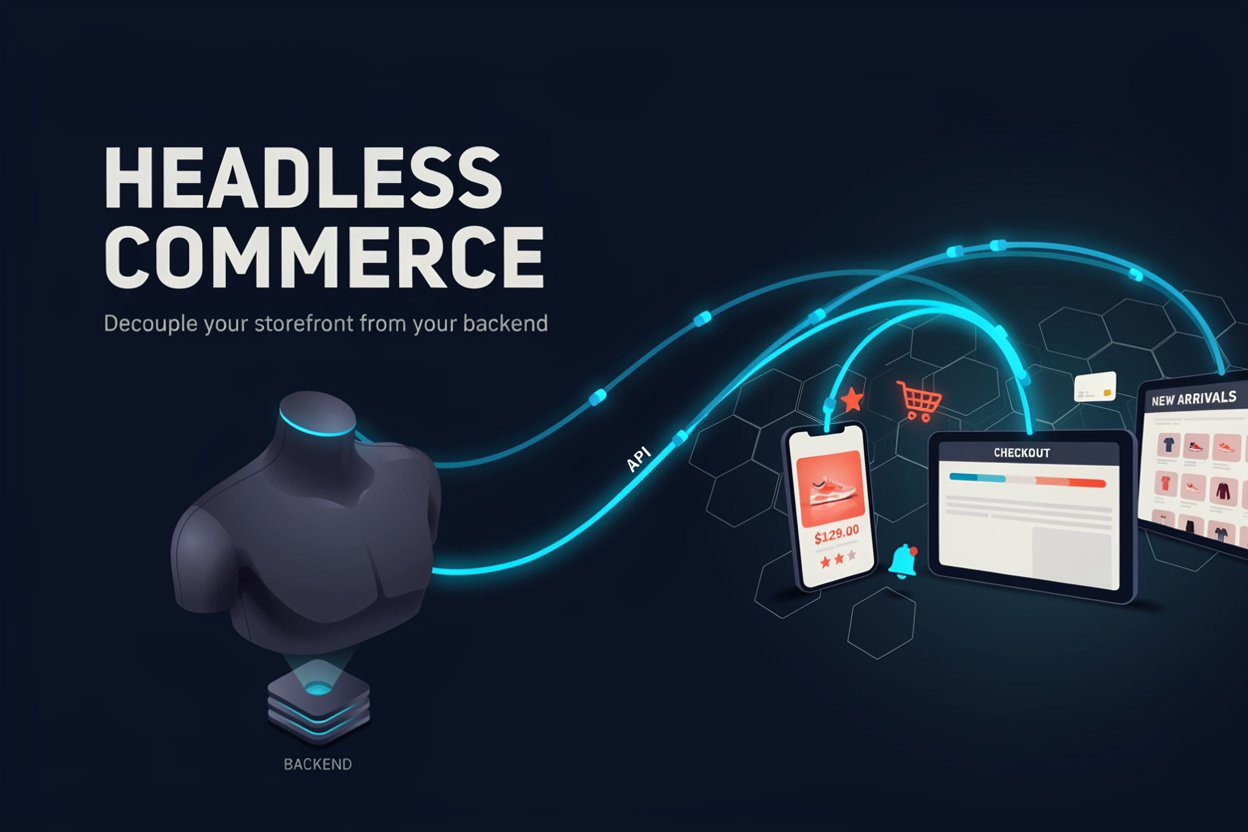
Social commerce trends 2026 can’t be ignored either. TikTok Shop, livestream shopping, and short-form video commerce all demand checkout integrations flexible enough to keep up. Creator commerce and affiliate commerce push this further, since brands increasingly need custom storefronts built around individual creator partnerships.
Then there’s the wider omnichannel shopping journey — customers now bounce between mobile, desktop, in-store, and social within a single purchase decision. Mobile shopping deserves its own mention too: with mobile the dominant channel for most product categories, page speed and Core Web Vitals translate straight into revenue.
Brands ask this before nearly every migration, and the honest answer depends on execution, not architecture.
On the upside: faster page speed and stronger Core Web Vitals are genuinely achievable, mostly because rendering strategy sits in your hands instead of being inherited from a platform decision made years ago. Server-side rendering or static generation keeps content crawlable without leaning on JavaScript rendering at crawl time. Full control over structured data, metadata, canonical tags, and clean URLs comes standard. Content flexibility means SEO-optimized landing pages without wrestling with a platform’s template, plus tighter internal linking control across product, category, and content pages.
There’s real risk on the other side too. A poorly configured headless build can accidentally block search engines from rendering content properly. Migrations without redirect mapping have tanked rankings overnight for brands that rushed the process. Some teams over-engineer client-side rendering without pairing it with SSR or static generation, and indexability quietly suffers for months before anyone notices.
Bottom line: SEO results come down to content quality, site authority, technical SEO execution, backlink profile, user experience, and how competitive the space is — not platform choice alone. Headless commerce in 2026 gives brands more capability to build something technically strong. It doesn’t guarantee rankings by itself, and no serious agency should promise otherwise.
A realistic roadmap for migrating to headless commerce in 2026 follows roughly this order, though the sequence shifts depending on team size and existing infrastructure.
Audit the current platform honestly first. Figure out what’s actually broken versus what’s just a design preference you’re tired of. Define business goals with real specificity — faster site, omnichannel expansion, custom UX, international growth.
Pick a frontend framework, usually Next.js or React storefronts. Choose an ecommerce backend based on catalog complexity and whether the business is B2B, B2C, or both. Pick a CMS that fits how the content team actually works, not whichever one had the flashiest demo.
Plan integrations before development starts — map PIM, OMS, ERP, CRM, and payment connections up front. Build an MVP storefront rather than launching everything at once. Migrate content and product data next, since this is usually where old technical debt finally surfaces.
Test SEO and Core Web Vitals before launch, not after. Launch with a phased rollout, proper redirects, and monitoring already running. Then keep watching analytics and conversions against the original business goals — server uptime alone doesn’t tell you whether the migration worked.
This fits a fairly specific set of businesses. Enterprise brands with complex catalogs and multiple business units fit naturally, as do fast-growing ecommerce stores that keep hitting the same platform ceiling month after month.
Multi-brand ecommerce and multi-storefront operations running several sites off one backend are strong candidates too, alongside international brands needing real localization, multilingual storefronts, and multi-currency checkout. B2B ecommerce and B2B2C ecommerce businesses juggling complex pricing, quoting, or account structures tend to outgrow traditional platforms faster than most expect.
Small stores with a limited budget, a simple catalog, or no development team, on the other hand, are usually better served by a well-optimized traditional Shopify, BigCommerce, or WooCommerce setup than a rushed headless build.
| Planning Area | What to Check | Why It Matters |
| Platform selection | Backend matches catalog complexity and B2B/B2C needs | Prevents costly re-platforming later |
| Frontend framework | Next.js, React, or PWA storefront chosen and scoped | Directly affects page speed and Core Web Vitals |
| CMS fit | Matches how the content team actually works | Avoids publishing bottlenecks post-launch |
| API and integrations | PIM, OMS, ERP, CRM, and payments mapped early | Reduces mid-build surprises and rework |
| SEO readiness | SSR/static generation, structured data, canonical tags planned | Protects rankings through the migration |
| Agency/vendor vetting | Portfolio, platform expertise, and SEO capability confirmed | Lowers risk of budget overruns |
| Migration plan | Redirect mapping and content migration scheduled | Prevents ranking loss during launch |
| Post-launch support | Maintenance plan and ownership defined | Keeps the stack stable long-term |
Rachel eventually rebuilt her storefront on a BigCommerce headless setup with a Next.js frontend — not because it was trendy, but because it solved the specific problems her old platform never could. That kind of migration takes real engineering discipline, the kind that’s much easier to plan for from the start than to bolt on after launch.
That’s the approach ASAPPStudio takes with every ecommerce project. As a digital product development team, we help ecommerce brands design, develop, test, and launch custom storefronts, headless commerce migrations, and AI-powered shopping experiences — with SEO and performance treated as part of the architecture, not an afterthought.
Our work spans custom software development, ecommerce development, web development, AI development, and staff augmentation for brands that need extra developer capacity during a migration. Whether you’re a growing DTC brand replatforming for the first time or an enterprise retailer scaling a multi-brand storefront, our services are built to handle the full lifecycle, not just the launch.
Planning a headless commerce migration in 2026? ASAPPStudio can help you design, build, and launch a headless commerce storefront built for speed, flexibility, and long-term growth.
1. What is headless commerce? Headless commerce separates the frontend, what customers see, from the backend commerce engine that runs products, orders, and payments, connecting the two through APIs.
2. How does headless commerce work? A frontend built in Next.js or React pulls product, content, and pricing data from backend systems through REST or GraphQL APIs, with each part of the stack running independently.
3. What is the difference between headless commerce and traditional ecommerce? Traditional platforms bundle frontend and backend into one system. Headless commerce splits them apart, trading some simplicity for a lot more customization.
4. What is the difference between headless commerce and composable commerce? Headless describes decoupling the frontend and backend specifically. Composable commerce applies that same modular thinking across the entire stack, CMS, search, and payments included.
5. Is headless commerce good for SEO? It gives brands more control over speed, structured data, and Core Web Vitals, which helps — but the SEO outcome still comes down to execution and content quality, not architecture alone.