
Dana Reyes hates when the phone rings after 9 p.m. It’s never good news at that hour, ever. On a Tuesday in March it was a driver stranded outside Columbus, Ohio — a blown turbo, forty miles from the nearest depot, a reefer trailer full of produce sitting there getting warmer by the minute, headed for a Kroger distribution center that was not going to be happy about a late load. Dana runs a 62-truck regional fleet out of central Ohio. She found out about that breakdown from her driver’s personal cell phone. Not from any system she owned. That’s the part that still bugs her, honestly.
Fast forward six months. The replacement engine in that same truck now reports its own health data every ninety seconds or so. Dana didn’t get a phone call the second time around — she got an alert, three days before a bearing would’ve failed, somewhere near Louisville, Kentucky, in roughly the same spot. No stranded driver. No spoiled produce. That’s basically the whole pitch for IoT Fleet Monitoring in 2026, packed into one anecdote: fleets that can see a problem coming beat fleets that find out about it from a driver’s cell phone.
What’s actually on the line if a fleet skips this shift? A handful of things, and none of them cheap:
This is a long one, but it walks through how IoT fleet monitoring actually works right now, what’s genuinely different about 2026 versus even two years ago, and what a fleet manager in Ohio, Georgia, Nevada — wherever — should be asking before signing anything with a vendor.
Ask ten fleet managers what IoT fleet monitoring means and you’ll probably get ten slightly different answers. Some think GPS, full stop. Others think of engine diagnostics. A few think of the driver-facing camera and stop there. None of them are wrong exactly, they’re just describing one slice of a bigger thing.
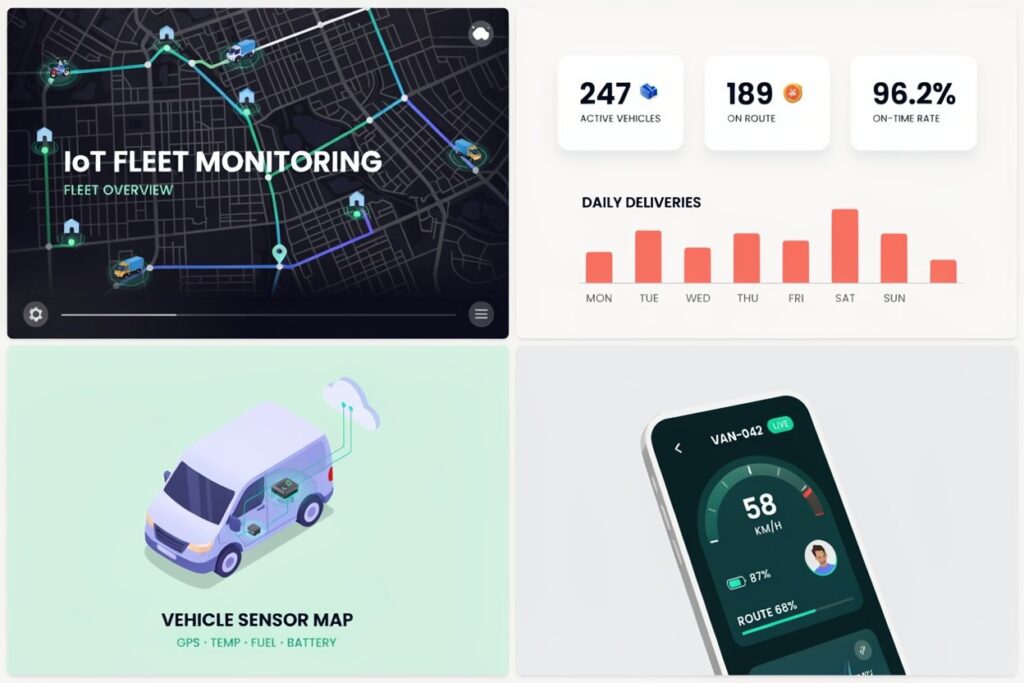
At its core, IoT fleet monitoring is connected sensors plus telematics hardware plus cloud software, all working together to track vehicles, cargo, and drivers in real time. Picture a nervous system bolted onto a truck — sensors feeling engine temperature, tire pressure, fuel burn, harsh braking, all of it — and shipping that data somewhere a person, or these days an algorithm, can act on it.
IoT fleet management pulls location data, vehicle health data, driver behavior data, and cargo condition data into one operational picture instead of five disconnected ones. How is IoT actually used in fleet management day to day? Mostly through small, rugged devices wired into a vehicle’s onboard diagnostics port, paired with cellular or satellite connectivity, streaming everything back to a dashboard someone’s actually watching.
And to be clear — IoT-based fleet monitoring isn’t one gadget you bolt under the dash and forget. It’s a stack. Hardware, connectivity, software, and the humans reading the dashboards. Skip any layer and the whole thing gets a lot less useful.
The architecture behind a modern IoT fleet monitoring system doesn’t look much like the clunky black boxes fleets were bolting under dashboards ten years ago. Worth breaking down layer by layer, because vendors love to blur these together in a sales deck.
Start with sensors. IoT sensors for vehicles now cover engine performance, brake wear, tire pressure, fuel levels, cabin temperature — a lot more than just “where’s the truck.” IoT sensors used in fleet management typically pull straight from a vehicle’s CAN bus data and OBD vehicle data streams, meaning richer diagnostics without a custom wiring job for every truck model in the yard.
Then connectivity, and this is genuinely where 2026 feels different from a few years back. 5G fleet connectivity has finally reached enough interstate corridors that near-instant data transmission is realistic rather than a marketing promise. For the fleets that run through the empty stretches of Nevada or rural Montana, satellite fleet connectivity picks up the slack cellular just can’t reach — no coverage bars, no problem.
Computing matters too, and it’s easy to overlook. Not everything needs to make the round trip to the cloud before something happens. Edge computing for fleets lets an onboard unit flag a critical event — say a sudden coolant spike — and fire a local alert in milliseconds, before the data even finishes uploading anywhere.
Last, software. This is the cloud fleet software, sometimes called IoT fleet monitoring cloud, where raw sensor noise turns into something a dispatcher can actually use — a fleet management dashboard showing every truck, its status, and whatever’s been flagged, all at a glance instead of forty browser tabs.
GPS tracking devices are still the backbone here, don’t get me wrong. But in a mature IoT fleet monitoring system architecture, GPS is one data stream among many. Not the whole story anymore, just the most familiar chapter.
Fair question, and one worth asking directly — why now? What changed that makes this year different from, say, 2023?
Three things, mostly. First: AI and IoT fleet management trends 2026 have converged in a way that just wasn’t practical two years back — the computer got cheap enough and the models got good enough. AI-powered fleet management platforms lean on machine learning for fleets to catch patterns buried in months of sensor logs that a human would never spot scrolling through spreadsheets. AI fleet analytics doesn’t just tell you what happened last week. It’s trying to tell you what’s about to happen next week, which is a very different (and much more useful) job. How does AI improve IoT fleet monitoring exactly? Pattern recognition, mostly, at a scale no dispatcher could match by hand across a fleet of any real size.
Second — connectivity got cheap and fast, and that matters more than it sounds. Alerts that used to take minutes to arrive now show up in seconds, which is a big deal when the event in question is a driver drifting out of a lane on I-75 outside Atlanta. That’s the practical answer to how 5G is changing fleet monitoring in 2026: latency, plain and simple.
Third, and honestly this one’s less flashy but arguably matters more long-term: connected vehicles are just the default now. New commercial trucks roll off the line with telematics-ready hardware already installed. Fleet connectivity stopped being an aftermarket add-on for a growing share of fleets — it ships standard, like power windows used to be an upgrade and now nobody thinks twice. Vehicle telematics and connected fleet management have basically merged into a single category at this point.
This is the feature every fleet manager asks about first. Always. Real-time fleet monitoring answers the question that used to require an actual phone call — where’s my truck right now, and is everything okay.
Real-time fleet tracking pulls real-time vehicle data — location, speed, status — into one feed. IoT vehicle tracking and IoT fleet tracking have become nearly interchangeable at this point, both describing the same core capability: knowing exactly where every asset sits, second by second, without guessing.
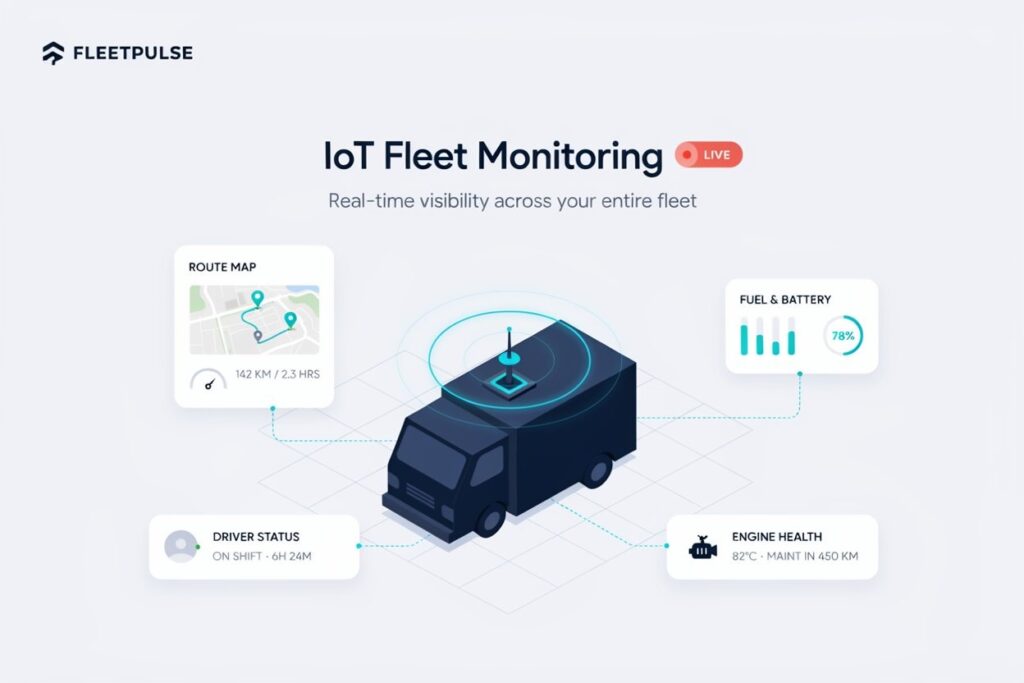
GPS fleet monitoring is still foundational, and commercial fleet tracking platforms build geofencing on top of it — draw a virtual boundary around a delivery zone, or somewhere a truck has no business being, and geofencing alerts fire the second a vehicle crosses it. Useful for security. Useful for compliance. And yes, useful for catching a driver who’s taken a personal detour on company time — not the most glamorous use case, but a real one.
Remote vehicle monitoring extends this beyond just location into fleet performance monitoring, fleet operations monitoring, and fleet asset monitoring, all surfaced on a centralized fleet dashboard a dispatcher can actually watch from one screen instead of juggling three logins. A smart fleet monitoring setup, a well-built vehicle fleet monitoring system, whatever you want to call it — it boils down to one thing. Nobody in the office should ever have to wonder where a truck is. That uncertainty is exactly what this whole category exists to kill.
Dana’s turbo story from the intro is basically the textbook case here. Predictive fleet maintenance is arguably where IoT fleet monitoring pays for itself the fastest, because breakdowns are expensive in ways that go well past the repair invoice — missed deliveries, a stranded driver, sometimes damaged cargo, and a customer who remembers the delay long after the truck’s fixed.
IoT fleet monitoring and predictive maintenance work together through continuous vehicle health monitoring. Sensors track engine health monitoring metrics, vibration signatures, oil quality, dozens of other signals — feeding a model trained to recognize the early fingerprint of a failure long before a dashboard warning light would ever trip.
Vehicle diagnostics used to mean a mechanic with a scan tool, once a quarter, whether the truck needed it or not. Now it’s continuous, running quietly in the background. Predictive maintenance alerts flag issues while the truck’s still rolling, giving dispatch time to route it toward a service bay instead of a shoulder somewhere. Preventive fleet maintenance shifts from “every 10,000 miles no matter what” to “exactly when the data says it’s actually needed” — which also saves money on parts replaced too early, a cost nobody talks about enough.
Maintenance scheduling built around real sensor data instead of a calendar is one of the clearest wins fleets report inside year one. Not the flashiest feature. Probably the most profitable one.
Nobody loves being watched, fair enough. But driver behavior monitoring isn’t really about catching people doing something wrong — it’s about catching a pattern before that pattern turns into a crash report.
Fleet safety monitoring platforms track harsh braking detection, aggressive acceleration, speed monitoring, and vehicle idling monitoring, building a picture of how each driver actually operates day to day, not just on their best behavior during a ride-along. Driver safety analytics turns that into a coaching conversation, ideally — not a punishment. Something like: “You’re braking hard three times a week on the same stretch near Nashville, let’s talk about the following distance.”
Driver performance data, tracked consistently over time, tends to change behavior on its own, honestly. Most drivers ease off once they know harsh events actually get logged somewhere. And IoT fleet monitoring for driver safety isn’t surveillance for the sake of it — insurers increasingly offer better rates to fleets that can prove safe operating patterns with real telemetry, not just a “we haven’t had a claim lately” story.
Fuel is usually the second-biggest line item on a fleet’s budget, right behind payroll. Fleet fuel monitoring aims straight at that number.
Fuel consumption analytics break down exactly where fuel disappears to — which routes burn hotter, which drivers idle the longest, which specific truck’s mileage has quietly gotten worse over the last six months. Fuel efficiency optimization follows naturally from that visibility: reroute around a stretch of I-40 in Tennessee that always sits in traffic, retrain a driver with heavy idling habits, or just retire a truck whose fuel curve never recovered after a repair.
IoT fleet monitoring for fuel efficiency typically pays back its own cost within the first year for mid-size and larger fleets — fuel savings alone often cover the platform fee, sometimes with room to spare. How does IoT actually help reduce fuel consumption? By turning “we think we’re burning too much” into “here’s the ten trucks running 12% hotter than fleet average, and here’s why.”
Beyond fuel specifically, fleet operating costs overall come down through better asset utilization — a truck sitting idle in the yard is a truck losing money, plain and simple — and vehicle uptime gains from the predictive maintenance work covered above. Fleet downtime reduction is really the same question as reducing fleet costs, just asked a different way.
Fleet route optimization software has gotten a lot smarter about factoring in live conditions — weather, traffic, delivery windows, even hours-of-service limits — instead of just calculating the shortest line on a static map, which is basically what most routing tools did until fairly recently.
Route planning software tied into an IoT fleet monitoring platform can reroute a truck mid-delivery when conditions shift. A paper route sheet obviously can’t do that. IoT logistics tracking extends this further for companies moving freight across multiple carriers or legs of a trip, and IoT fleet monitoring for logistics companies usually needs to talk to whatever systems are already running the show — TMS integration and ERP integration matter a lot here, more than most vendors admit up front. Can IoT fleet monitoring actually integrate with TMS and ERP software? Generally, yes, through a documented fleet management API pushing location, status, and diagnostic data into whatever already handles dispatch, billing, or inventory.
Fleet data analytics and automated fleet reporting round this out. Instead of a dispatcher compiling a weekly performance report by hand on a Friday afternoon, the platform generates it automatically, pulled straight from the live data stream.
For fleets hauling anything perishable, cargo condition monitoring matters just as much as knowing where the truck is. Cold chain fleet monitoring tracks trailer temperature, humidity, and door-open events the whole trip, not spot-checked at pickup and delivery like it used to be.
IoT fleet monitoring for cold chain logistics matters because a single undetected temperature swing can ruin an entire truckload of pharmaceuticals or produce — and nobody finds out until it’s already at the customer dock. Dana’s product shipment, the one from the opening story, had a reefer unit reporting temperature every few minutes. When it drifted two degrees out of range near the Ohio-Kentucky line, dispatch knew within seconds. Not after a rejected delivery and an angry phone call.
EV fleet monitoring has become its own category, as more fleets in California, New York, and increasingly the Midwest mix electric trucks and vans into their operations. IoT fleet monitoring for electric vehicles tracks battery state of charge, charging cycles, remaining range against actual route distance, and battery degradation over time — none of which a diesel fleet ever had to think about.
Can IoT monitoring work for electric vehicle fleets? Absolutely, and arguably it matters even more for EVs, where range anxiety and charging logistics turn real-time visibility into something genuinely operational rather than a nice-to-have dashboard feature.
Every connected sensor is also a potential doorway in, and that’s not a small concern once a fleet is running hundreds of them across a state or three.
Fleet cybersecurity needs to be part of the conversation from day one, not patched on after a breach makes the local news. IoT device security means firmware that actually gets updated, credentials that aren’t hardcoded from the factory, and network segmentation between vehicle systems and the rest of the corporate network. Fleet data encryption, both in transit and at rest, protects location history, driver data, and cargo details from getting intercepted by someone who has no business seeing them.
The big risks tend to be the boring ones — unpatched devices, weak default passwords nobody bothered to change, data intercepted mid-transit. Securing fleet IoT data comes down to encrypted connections, regular firmware updates, and tight access controls on who can view or export anything.
Regulatory compliance — hours-of-service logging, emissions reporting, DOT requirements — increasingly runs through the same platform now, which is convenient when it works and a headache when it doesn’t. Carbon emissions tracking has become close to standard too, part regulatory pressure, part shippers wanting to report their own supply chain emissions accurately to their customers.
Worth clearing up, because these terms get thrown around loosely and it causes real confusion during vendor calls. Fleet telematics, historically, meant GPS location plus some basic engine data. That’s about it.
The difference between fleet telematics and IoT, in plain terms, is scope. Traditional telematics is mostly about where a vehicle is. IoT fleet monitoring is about everything happening on and around the vehicle — engine health, cargo condition, driver behavior, fuel burn, and location, all in one system instead of five. GPS tracking is one input into that bigger picture. An IoT fleet management system treats it as one data stream among dozens, not the star of the show.
This is usually where fleet managers get stuck. Not because the technology is confusing, exactly, but because the vendor landscape is crowded and every sales deck sounds identical after the third demo call.
Best IoT fleet monitoring solutions for small to medium businesses tend to prioritize fast setup and simplicity over deep customization — which makes sense, nobody running 15 trucks wants a six-month implementation. Top IoT fleet monitoring platforms with real-time tracking, and the top providers of real-time fleet tracking solutions more broadly, mostly differentiate on integration depth these days — how well they plug into an existing TMS, ERP, or payroll system — rather than raw sensor accuracy, which has largely become commoditized across the whole industry at this point.
A short list of what actually matters when narrowing down a provider:
| What to Check | Why It Matters |
| Hardware installation time | Days of downtime per truck add up fast across a fleet |
| Data ownership terms | Some vendors lock historical data behind their own platform |
| TMS/ERP integration | Avoids duplicate data entry across systems nobody wants to maintain |
| Offline/edge capability | Rural routes need local processing, not just a cloud dependency |
| Security certifications | Ask directly about encryption standards and patch cadence |
| Scalability | Should grow from 20 trucks to 200 without a full platform switch |
Which IoT devices actually get used in fleet management? Typically a mix of OBD-II telematics units, dash cameras, temperature sensors for reefer units, and tire pressure monitors — the exact combination depends heavily on cargo type and vehicle class, so there’s no single universal answer here.
Implementation, when it goes well, tends to follow a similar path across most fleets: pilot on a small subset of vehicles first, validate data accuracy against known routes and known maintenance events, then scale fleet-wide over roughly 60 to 90 days. A good implementation guide prioritizes driver buy-in early, because a system driver’s resent gets sabotaged one way or another, intentionally or not.
Cost varies more than most vendors like to admit — generally a modest monthly per-vehicle software fee plus one-time hardware costs, though pricing depends heavily on sensor complexity and how much integration work is needed. Ask any vendor for a per-vehicle, all-in number before signing anything. Hidden integration fees are where budgets usually blow up six months in.
The real challenges fleets run into aren’t usually technical — driver resistance, integration headaches with legacy systems nobody wants to touch, and alert fatigue from notification thresholds that were never tuned properly top the list most fleet managers report. And the data these systems collect, for the record, covers location, speed, engine diagnostics, fuel level, harsh event logs, cargo temperature, driver hours, and increasingly camera footage tied to specific flagged events.
The benefits stack up across everything covered above — fewer breakdowns, safer driving, lower fuel spend, tighter delivery windows, and a stronger position when insurance renewal season rolls around. Why does IoT matter more for fleet management specifically in 2026? Because competitors already running it are quoting tighter margins and delivering more reliably, and freight customers have started asking about it directly during vendor selection now, not just as an afterthought.
Where’s this heading next? AI-driven predictive analytics, 5G-enabled low-latency alerts, deeper EV-specific monitoring, and tighter TMS/ERP integration are the trends showing up on nearly every fleet’s technology roadmap right now. The direction seems pretty clear — fewer standalone dashboards, more unified platforms where fleet data, financial data, and customer-facing tracking all live in one place instead of three.
Fleets rarely need “an app.” What they actually need is a system — sensors that report accurately, a dashboard dispatch genuinely trusts, and integrations that don’t break every time the ERP gets patched. That’s a build problem as much as a buying problem, and it’s exactly where a custom approach tends to beat an off-the-shelf platform stretched thin to fit.
ASAPPStudio’s IoT development services team builds fleet monitoring systems from the sensor layer up, tailored to the vehicles, cargo, and routes a fleet actually runs — not forced into some generic template built for a different industry entirely. When a platform needs predictive maintenance modeling or driver-behavior pattern detection, our artificial intelligence team builds that analytics layer directly into the dashboard, not bolted on as an afterthought. And since nearly every fleet already runs a TMS, an ERP, or both, our software development services team handles the integration work that turns a standalone tracking tool into a genuinely unified operations platform.
Curious what a custom-built fleet monitoring system would actually look like for your operation? Get in touch with our team — no generic sales deck, just a straight conversation about your trucks, your routes, and what’s worth building first.
1. What is IoT fleet monitoring?
Connected sensors and cloud software tracking vehicle location, health, and driver behavior in real time, all in one dashboard.
2. How much does an IoT fleet monitoring system cost?
Costs vary by fleet size and sensor complexity — expect a per-vehicle monthly fee plus one-time hardware installation.
3. How does IoT reduce fleet operating costs?
Catching maintenance issues early, cutting fuel waste, and reducing downtime — turning guesswork into data-backed calls.
4. What’s the difference between telematics and IoT fleet monitoring?
Telematics mainly tracks location. IoT fleet monitoring adds engine health, cargo condition, driver behavior, and more.
5. Can IoT fleet monitoring work for electric vehicle fleets?
Yes — EV fleet monitoring tracks battery charge, range, and degradation alongside standard location and safety data.