
Rosa Delgado didn’t set out to become the person who fixed her company’s data mess. She just wanted to stop apologising to customers.
Her skincare brand, based out of Austin, Texas, had grown fast — fast enough that nobody noticed the cracks until a regular customer called support furious. She’d been emailed a “we miss you” discount code the same week she placed her third order that month. Rosa pulled up three different dashboards trying to figure out what happened. Her Shopify store said one thing. Klaviyo said another. The support desk had no idea any of it existed. Three systems, three versions of the same person, and not one of them talking to the others.
Somebody on her ops team finally said it out loud: you need a customer data platform. Rosa had heard the term in passing. She didn’t really know what it meant, or which one to pick, or whether the whole thing was worth the headache.
That’s more or less why you’re here too, probably. So let’s actually work through it — what a customer data platform does, how the best customer data platforms in 2026 stack up against each other, and how a company that looks nothing like a Fortune 500 enterprise picks the right one without torching six months and a big chunk of budget.
It’s easy to treat this like a shopping decision. It isn’t, really. Get it wrong and the damage shows up fast, usually inside a single quarter.
Marketing teams re-target customers who have already converted, because the segment data lives in one tool and the purchase data lives in another, and nobody stitches them together. Support agents pick up a call with zero context — no order history, no idea the customer already emailed twice this week — so calls run long and people get annoyed. AI agents answer from whatever scraps of data they can grab, which on a bad day means confidently wrong answers to customers who are already frustrated. Compliance teams lose actual sleep over GDPR and CCPA requests, because “give me every piece of data you have on this person” turns into a scavenger hunt across five systems nobody fully owns. And engineering keeps duct-taping one-off pipelines between tools that were never meant to talk to each other in the first place, instead of just running one customer data platform built for exactly this job.
None of that is hypothetical. Ask a dealership network in Ohio managing loyalty data across forty locations, or a hospitality group in Florida juggling reservations, loyalty points, and email preferences across a dozen properties. It’s the same story with a different logo on it.
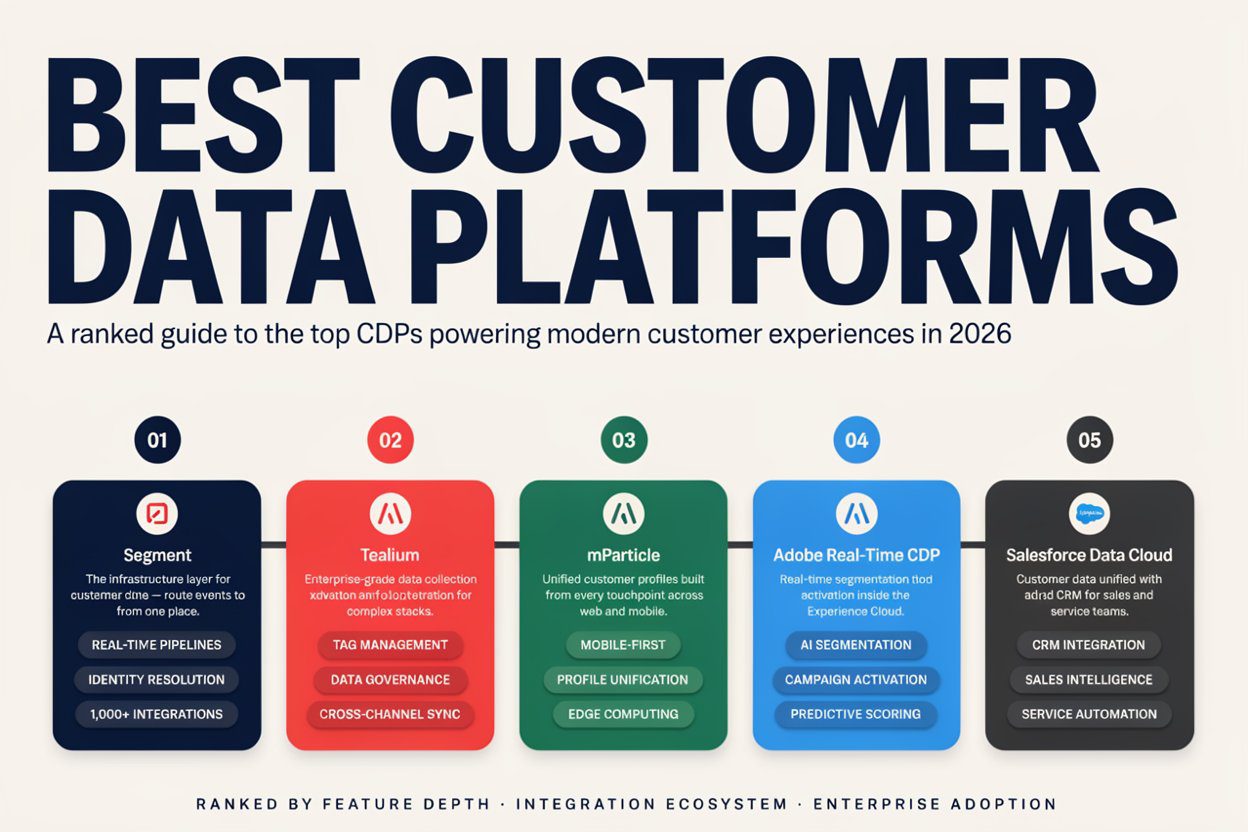
Strip away the marketing copy and a customer data platform does something fairly simple: it pulls in behavioral, transactional, and demographic data from every tool a business runs — CRM, point of sale, the app, the website, support tickets, email opens — and resolves it into one unified customer profile. Some people call this a customer 360. Others call it a single customer view. Same idea either way. That profile then gets made available, in real time, to whatever needs it next: an ad platform, an email tool, an AI agent mid-conversation, a dashboard someone’s staring at during a Monday standup.
That’s roughly how customer data platforms work, at least at the level that matters for a buying decision. The deeper answer depends a lot on architecture — and this is where a lot of buyers trip themselves up without realizing it.
Two very different flavors exist, and conflating them is probably the single most expensive mistake on this list.
Packaged CDPs ship with their own data store baked in. You feed data in, the platform owns and manages the storage, you pull audiences back out for activation. Quick to launch. This used to be the only real option.
Composable CDPs — sometimes called warehouse-native CDPs — sit on top of a cloud data warehouse a company already owns, whether that’s Snowflake, BigQuery, or Databricks, instead of duplicating everything into a new proprietary silo. No second copy of your data sitting around. Less vendor lock-in. A real answer, finally, to the zero-copy data activation problem that’s been a headache for years. Composable is the fastest-growing category among customer data platform vendors going into 2026, mostly because data teams got tired of paying twice to store the exact same customer record.
Worth saying plainly: composable doesn’t automatically win. It usually asks more of an in-house data engineering team than a packaged CDP does. If your team is lean, that trade-off is real, and it’ll bite you six months in if you ignore it now.
Before anyone opens a vendor comparison page, this is usually the question sitting in the back of their mind.
| Customer Data Platform (CDP) | CRM | DMP | |
| Primary data | First-party, known + anonymous | First-party, known contacts only | Third-party, mostly anonymous cookies |
| Update speed | Real-time or near real-time | Manual or batch | Batch, cookie-based |
| Owns identity resolution | Yes | Limited | No |
| Built for activation | Yes, across many channels | Sales and service workflows | Ad targeting only |
| Survives cookie deprecation | Yes | Yes | Largely obsolete |
Here’s the short version of a CDP vs CRM comparison: your CRM knows who your sales reps talked to. Your CDP knows what every customer did everywhere — including plenty of channels your CRM never even sees. A CDP vs DMP comparison resolves even faster in 2026, honestly, because third-party cookies are basically dead weight now and DMPs were built entirely around them. Most serious buyers aren’t really weighing a CDP against a CRM anymore. They’re weighing packaged CDP vs composable CDP, which is a much harder — and much more useful — question.
Here’s the honest rundown of the top CDP vendors worth putting on a shortlist this year. No filler, no vendor-supplied talking points — just architecture, pricing shape, and who each one genuinely fits.
| Platform | Best For | Architecture | Standout Feature | Pricing Model |
| Twilio Segment | Developer-led teams, real-time pipelines | API-first, packaged + warehouse options | Strong SDK library, reliable event streaming | Usage-based (MTU) |
| Salesforce Data Cloud | Enterprises already on Salesforce | Warehouse-native | Deep native CRM tie-in | Enterprise contract |
| Adobe Real-Time CDP | Large B2C brands, media and retail | Packaged, real-time | Native Adobe Experience Cloud activation | Enterprise contract |
| Tealium Customer Data Hub | Privacy-heavy industries, omnichannel retail | Packaged, strong tag-management roots | Consent management built in | Tiered by data volume |
| Treasure Data CDP | Enterprises with messy, siloed data sources | Hybrid, warehouse-friendly | Treasure AI predictive layer | Enterprise contract |
| Amperity CDP | Retail and hospitality identity resolution | Packaged, identity-first | Best-in-class probabilistic matching | Enterprise contract |
| ActionIQ CDP | Marketing-led orchestration teams | Composable, warehouse-native | Journey orchestration on live warehouse data | Usage-based |
| mParticle CDP | Mobile-first and app-heavy businesses | API-first, packaged | Mobile SDK depth | Usage-based (MTU) |
| Bloomreach CDP | Mid-market eCommerce | Packaged, commerce-first | Product and customer data unified | Tiered |
| Insider One CDP | Fast-growing eCommerce and B2C brands | Packaged, AI-native | Built-in AI agent and journey builder | Tiered by contacts |
| Oracle Unity CDP | Large enterprises on the Oracle stack | Packaged | Native Oracle CX integration | Enterprise contract |
| Emarsys / Optimove | Retention and lifecycle marketing teams | Packaged | Predictive lifecycle campaigns | Tiered |
| DataOS customer data platform | Data teams wanting full composability | Fully composable | No proprietary data copy | Usage-based |
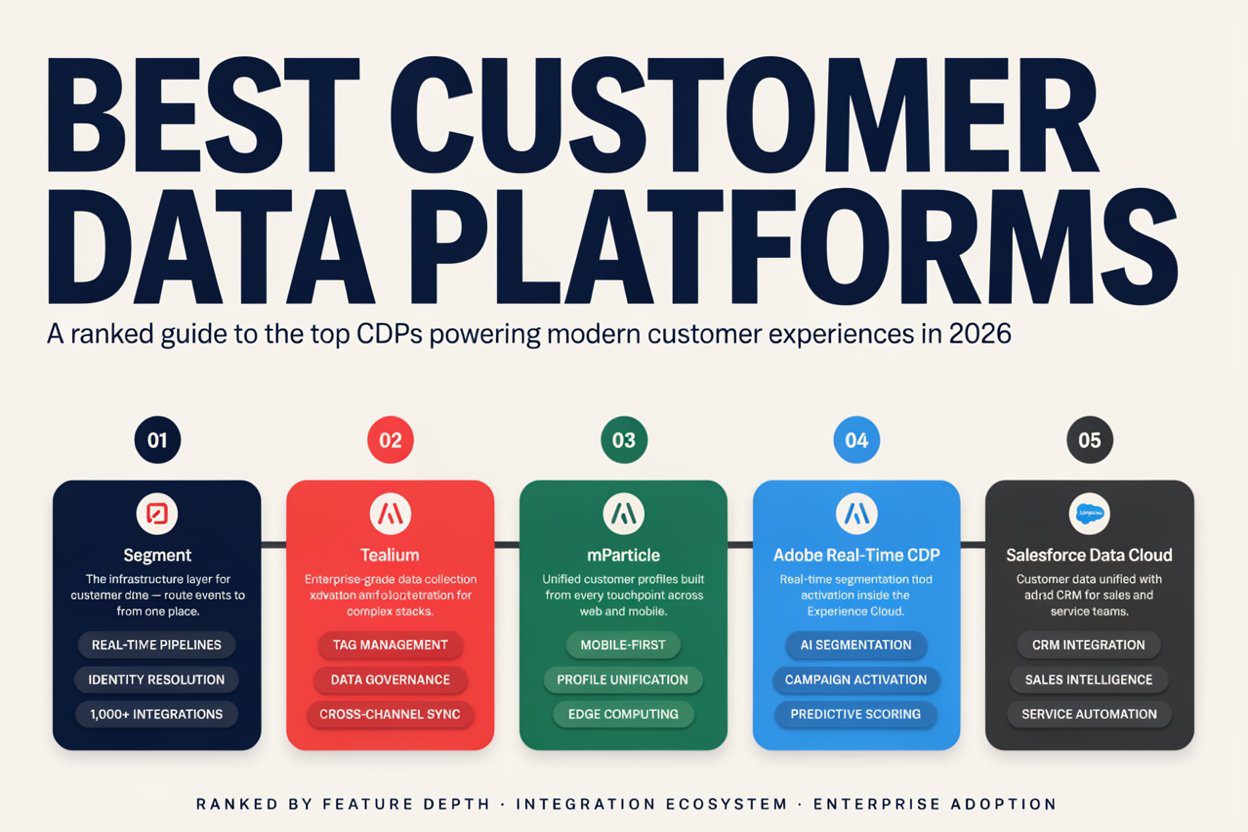
A quick word on that Insider One vs Twilio Segment debate, or Amperity vs Twilio Segment if you’ve seen that one — it usually comes down to one question. Do you want marketing-ready journeys out of the box, which is where Insider One and Bloomreach shine? Or do you want raw, developer-controlled event infrastructure you’ll build your own workflows on top of, which is Segment and mParticle’s whole pitch? Neither answer is wrong. They’re just built for different teams solving different problems.
Every vendor in that table will tell you they offer real-time customer profiles. Fewer of them are actually good at the hard part underneath — customer identity resolution, which is a fancy way of saying “matching an anonymous website visitor to a known customer without guessing wrong.”
Two approaches show up over and over:
Deterministic identity resolution matches on hard identifiers — email address, login ID, loyalty number. Accurate when it works, but it completely misses anonymous traffic. If someone’s browsing without logging in, deterministic matching has nothing to grab onto.
Probabilistic identity resolution leans on behavioral signals instead — device fingerprint, location, browsing pattern — to estimate a match. Covers way more traffic. Comes with some margin of error, which not everyone loves.
The platforms that actually earn their price tag blend both, and keep refining the profile as new signals roll in through streaming data ingestion rather than waiting on an overnight batch job. That one distinction — real time versus batch — is basically the line between a platform that can power a live AI support agent and one that’s only really good for next week’s email campaign.
This part is genuinely different from where CDP conversations were even two years back. AI agents answering support questions, resolving tickets, recommending products — they need live access to a full customer record the instant a conversation starts. Order history. Past chats. Loyalty status. Not a nightly export from three days ago.
A customer data platform for AI agents means clean, low-latency APIs an agent can call mid-conversation, plus a memory layer that persists across sessions instead of resetting every time. AI-ready customer data isn’t a nice phrase on a slide — it’s the difference between an agent that sounds like it knows the customer and one that’s obviously guessing. Anyone shortlisting a platform specifically for this use case should ask one blunt question in the sales call: how fast does an external API call actually return a full unified profile, and what’s the uptime guarantee sitting behind that number.
There’s no universal winner here, and anyone who tells you otherwise is probably selling something. There’s a right fit for your stack, your team size, and your budget.
Best CDP for enterprise: Salesforce Data Cloud, Adobe Real-Time CDP, or Oracle Unity. If you’re already deep in one of those ecosystems, the native tie-in usually beats everything else on this list combined.
Best CDP for startups and small businesses: Twilio Segment or Insider One tend to have the gentlest onboarding curve, and pricing that doesn’t punish you for being small.
Best CDP for eCommerce and B2C companies: Bloomreach, Insider One, or Amperity — all three were built around product catalogs and purchase behavior, not generic event tracking bolted on afterward.
Best CDP for developers: Segment, mParticle, or a fully composable pick like DataOS, if your team would rather own the pipeline logic than work inside somebody else’s pre-built journey builder.
| Question | Why It Matters |
| Real-time streaming, or just batch sync? | Decides whether AI agents and live personalization actually work |
| Packaged or composable — does it match your data team’s size? | Composable demands real engineering hours upfront |
| How accurate is identity resolution on anonymous traffic? | Directly shapes segmentation and ad targeting quality |
| Priced on contacts, events, or a flat enterprise fee? | Usage-based pricing can spike hard and fast at scale |
| Native consent management and audit trails? | Bolting compliance on later costs more and moves slower |
| How many pre-built connectors ship out of the box? | Fewer connectors, more custom integration work down the road |
| What’s the honest implementation timeline, not the sales-deck one? | A lot of “six-week” rollouts quietly stretch past four months |
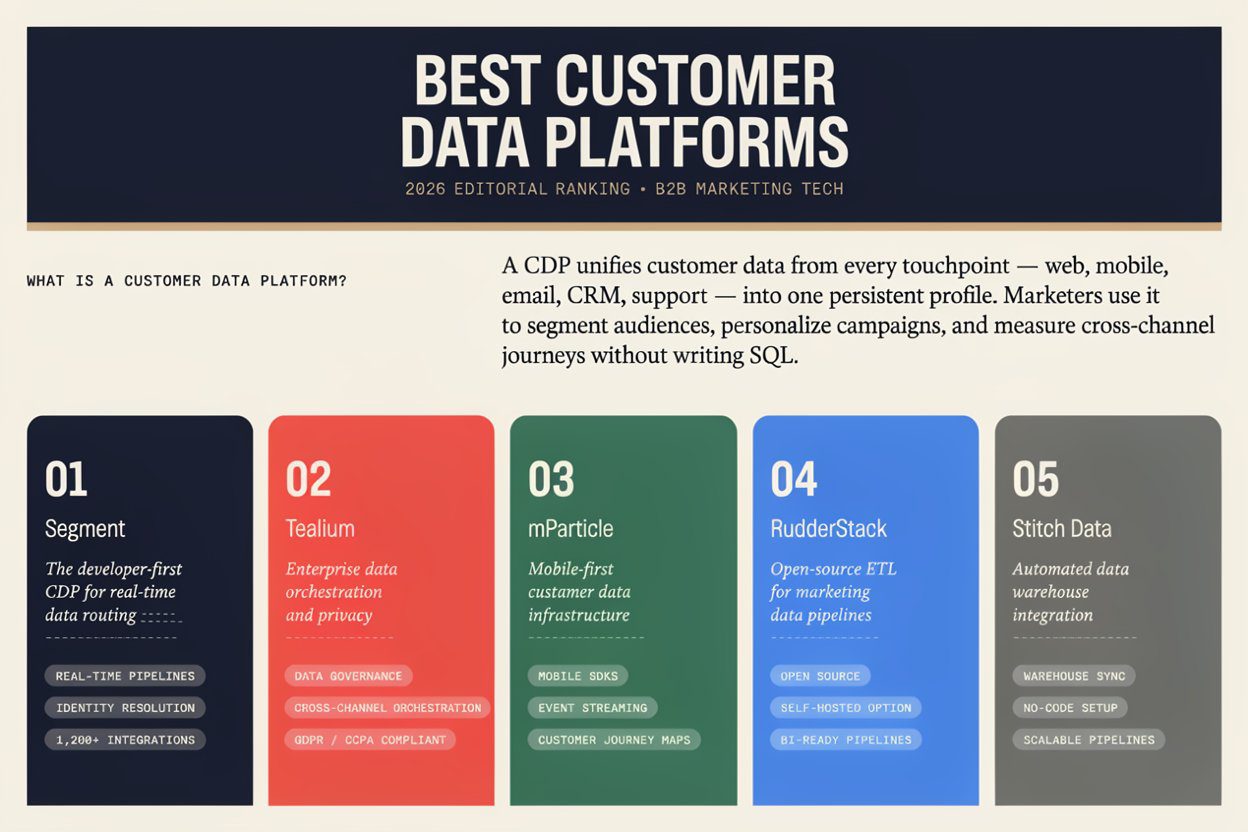
Customer data platform pricing swings more than most buyers expect, and it doesn’t map cleanly to company size the way you’d think. Usage-based platforms priced on monthly tracked users or event volume can look cheap in a demo and then double by year two as traffic grows — nobody warns you about that part upfront. Enterprise-contract platforms front-load the cost, but at least it stays flat. A mid-market brand pushing a few million events a month should budget implementation separately from the license itself. Data mapping, connector setup, identity resolution tuning — all of that routinely takes longer than the sales deck implies, especially once someone actually looks at how messy the legacy CRM data really is. Garbage in, garbage out isn’t just a tired phrase. It’s the single biggest reason CDP rollouts stall out.
No conversation about CDP data governance skips regulation in 2026, full stop. A GDPR-compliant customer data platform and a CCPA-compliant CDP need to do more than store a checkbox somewhere. They need enforceable consent management, a right-to-be-forgotten workflow that actually deletes data across every connected destination — not just the primary database — and data lineage clean enough to hand an auditor without a mad scramble beforehand. Tealium and Salesforce Data Cloud both lean hard into this, and for good reason. A failed audit or a data breach costs a lot more than the platform itself ever will.
Picking a customer data platform off a comparison chart is the easy part, honestly. Wiring it correctly into your CRM, your app, your website, and your support stack — that’s where most projects quietly stall out. ASAPPStudio works with U.S. companies on exactly this kind of integration, from Texas eCommerce brands to enterprise teams on the East Coast.
Our Artificial Intelligence team builds the AI agent and automation layer that reads live from your CDP, so support and sales conversations run on real context instead of a stale export from last night. Our Custom CRM Development team handles the CRM-to-CDP sync so identity resolution actually reflects your live sales data, not a snapshot from three weeks ago. If your customer data platform implementation needs custom connectors your vendor doesn’t ship, our Software Development Services team builds them instead of forcing your stack to bend around someone else’s limited list. For brands specifically comparing options for the best CDP for eCommerce, our Ecommerce Development team connects product and order data straight into the unified profile. And we run Quality Assurance passes on every pipeline before go-live — a CDP with broken identity matching is arguably worse than no CDP at all.
Need extra hands during the rollout itself? Our Staff Augmentation service places data engineers directly on your project, working alongside your team instead of handing you a black box. Get in touch and we’ll map out what your stack actually needs before you sign anything with a vendor.
1. What is the best customer data platform in 2026?
No single winner exists — Segment fits developers, Insider One fits eCommerce, Salesforce Data Cloud fits Salesforce-heavy enterprises best.
2. What is the difference between a CDP and a CRM?
A CRM tracks sales conversations with known contacts. A CDP unifies known and anonymous behavior across every channel, live.
3. Which CDP is best for AI agents?
Insider One and Treasure Data lead here — fast APIs, persistent memory layers built for live agent conversations, not batch exports.
4. Is a composable CDP better than a packaged CDP?
It avoids vendor lock-in and duplicate storage, but needs stronger in-house data engineering. Packaged still launches faster.
5. How much does a customer data platform cost?
Ranges from usage-based pricing per tracked user to enterprise contracts. Budget implementation separately — it often runs long.