
A client in Denver asked me last month whether they should “just go serverless already.” He’d read three blog posts and one Reddit thread and was ready to sign off on a rebuild. I told him to slow down. Not because it’s a bad idea — for his product it was actually a pretty good one — but because almost nobody asking that question has thought past the buzzword.
This post is me trying to fix that, at least a little. We’re covering Serverless Architecture in 2026 the way I’d actually explain it if you sat across from me and asked. Not a Wikipedia rewrite. What it is, what it does to your bill, where it saves you from yourself, and where it’ll bite you if nobody’s paying attention. Doesn’t matter if you’re running a warehouse app out of Ohio or a fintech product in San Francisco — this is shaping how the next app gets built either way.
What is serverless architecture, really? The name is a little bit of a lie, honestly. The servers didn’t go anywhere. Somebody’s machine, somewhere, is still doing the work. What changed is that it’s not your machine anymore, and it’s definitely not your problem when it needs patching at 3am.
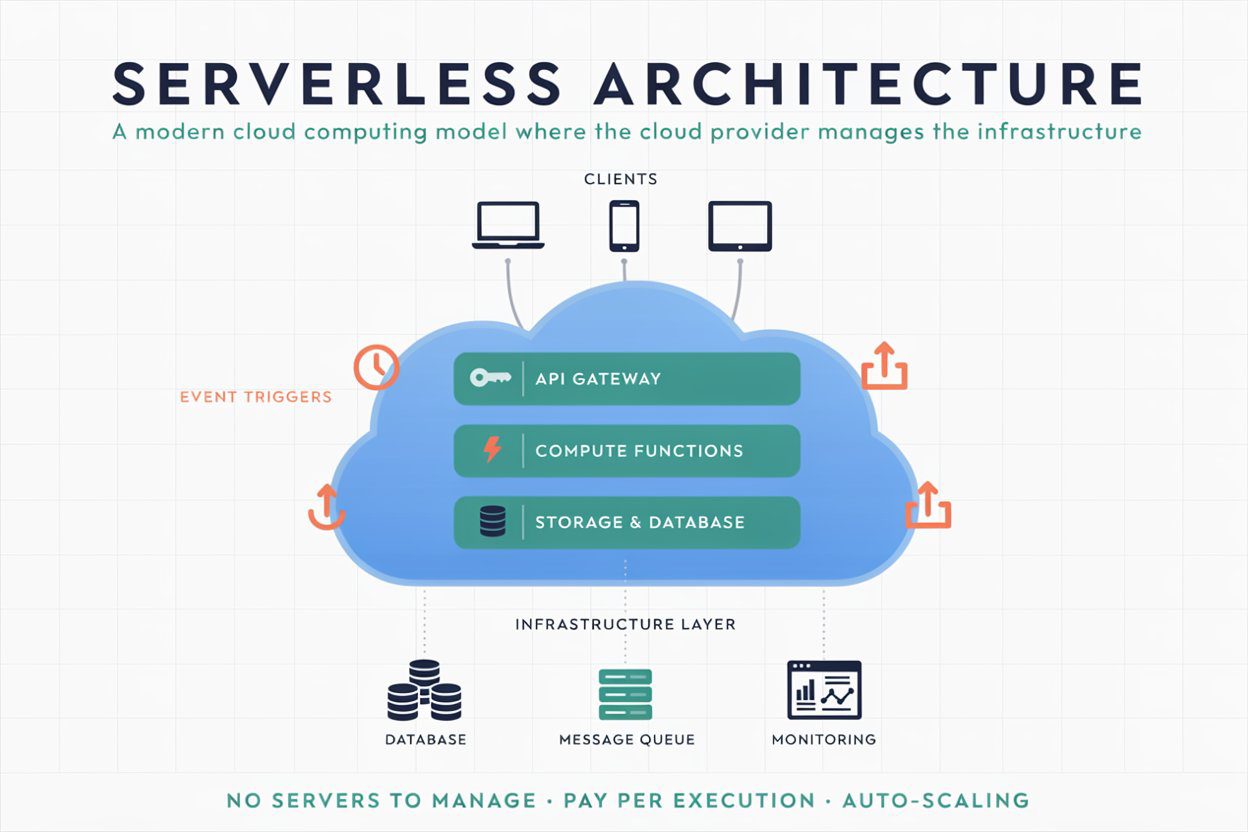
Two pieces hold most of this together. Function as a Service — FaaS if you want the short version — is small pieces of code that wake up, do exactly one thing, and go back to sleep. Backend as a Service, BaaS, is the databases and login systems and storage you’d normally build yourself, except now you just plug into someone else’s version.
That’s really it. You write the logic. Someone else deals with everything underneath.
Forget the sales pitch for a second. If you want how serverless architecture works in plain terms, it comes down to one word — triggers. Nothing runs until something asks it to.
Somebody fills out a form — HTTP request trigger. A row changes somewhere in a database — database trigger. A file gets dropped into storage — file upload trigger. A cron job hits 2am — scheduled task trigger. Something lands in a queue — message queue trigger. Every single time, the provider spins up a brand new, isolated execution environment just for that one job, runs it, hands back whatever it produced, and shuts it down again. You don’t pay for the gap in between. There is no gap in between, really.
This is what people mean by event-driven serverless architecture, and it’s why a retailer can survive a Black Friday spike without owning extra hardware the other 364 days of the year. Functions don’t hold onto state between calls, and thousands of concurrent executions can fire off at once without a human adding capacity anywhere. If your traffic looks less like a flat line and more like a heartbeat monitor, this matters a lot.
Most of this trigger logic gets built directly into client projects through our custom software development work — it’s genuinely where the engineering decisions live, not in whatever slide deck sold the idea originally.
There’s no shortage of serverless computing platforms, but three keep coming up in almost every U.S. conversation I have.
AWS Lambda is still the default for most teams. Part of that’s inertia, sure, but it’s mostly because it plugs so cleanly into the rest of AWS serverless architecture — API Gateway, DynamoDB, S3 triggers, all talking to each other without much fuss. Azure Functions makes sense the second your company already lives inside Microsoft’s ecosystem; it ties into Active Directory and existing DevOps pipelines without a fight. Google Cloud Run functions have been picking up steam too, especially with teams doing heavier AI inference work who want more container flexibility than a strict FaaS model gives them.
I get asked constantly what the actual difference between AWS Lambda and Azure Functions is, or Lambda versus Google Cloud Functions. It’s rarely about raw speed. It’s about where your team already has instincts built up, how cold starts behave for your specific traffic, and whether the pricing matches how your app actually gets used.
People use these interchangeably and it drives me a little crazy. Serverless architecture vs microservices is really about how small you’re willing to go. Microservices split an app into independent services, but those services often still sit on containers running around the clock. Serverless goes one level deeper — individual functions that exist only while they’re doing something.
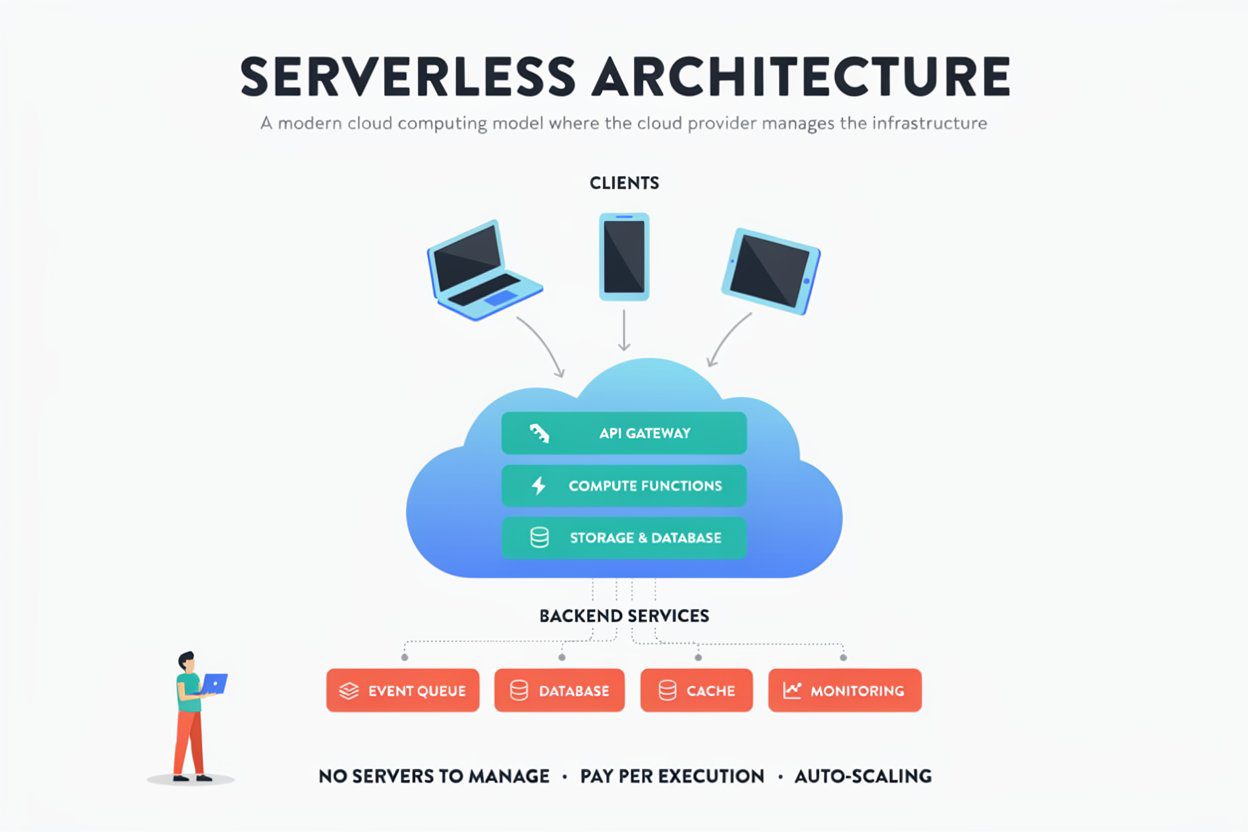
You can blend both, and we do, constantly. A lot of what gets built ends up as serverless microservices — each service broken into a handful of FaaS functions rather than one container that never sleeps. What comes out the other end is a serverless backend architecture that costs almost nothing when it’s quiet and scales the moment it isn’t, without anyone babysitting a container fleet.
Ask ten teams why they moved and you’ll hear the same three or four things, honestly. Automatic scaling is usually first — the app grows and shrinks on its own, no human involved. Pay-per-execution billing sounds small until you actually stare at an old cloud invoice and realize how much of it was paying for servers doing absolutely nothing. Faster serverless application development matters too, since skipping provisioning means code gets from written to live noticeably quicker.
There’s a quieter one people don’t say out loud as often — fewer emergencies. Reduced operational overhead means your team isn’t the one on call when a server dies, mostly because there isn’t really a server in the way you’d traditionally picture one. And most managed cloud services replicate functions across zones without you designing for it, so high availability just kind of… comes with the package.
For a business in Texas trying to grow without doubling its infrastructure spend, or a startup in Colorado watching every dollar, that combination usually settles the decision fast.
I’d be lying if I said this was all upside. There are real serverless architecture challenges, and a few of them show up exactly when you’re not expecting it.
Cold starts are the complaint I hear most. A function that hasn’t run in a while needs a fresh execution environment spun up before it can do anything, and that pause shows up as latency your actual user feels, not just a number in a dashboard. Vendor lock-in is quieter but arguably worse long-term — the more you lean on one provider’s proprietary tools, the harder leaving gets later, even when leaving would genuinely save money. State management is its own thing entirely, because functions are stateless on purpose, so anything you need to remember between calls has to live somewhere else now, usually a database you’re suddenly designing around. Debugging gets harder too — tracing a request through a dozen functions that only existed for a few milliseconds each isn’t anything like stepping through one running server. And most FaaS platforms cap how long a function’s allowed to run, period, which rules certain long jobs out of this world entirely.
None of that makes serverless a bad call. It just means somebody who’s actually done this before needs to be drawing the lines — which is most of what our software development team is doing before a single function ever gets deployed.
Since this question comes up more than almost anything else — how do you actually cut down cold starts? Provisioned concurrency helps, keeping a small number of instances warm on standby. Trimming the function’s package size helps too, less to load means less time waiting. Lighter runtimes where you have the option. And scheduling small keep-alive pings during hours you already know traffic’s coming. None of it makes cold starts disappear. It just takes the edge off enough that users stop noticing.
Is serverless architecture cost-effective? For anything that swings up and down without warning, usually, sometimes by a lot. For something running flat-out around the clock at high volume, a reserved setup can occasionally still win. That gap is exactly why serverless cost optimization turned into its own little corner of cloud consulting.
If you’re trying to actually price this out, look at function execution time, memory allocated per invocation, how many times things actually get called each month, and whatever data transfer plus API Gateway requests are riding along with it. The costs that sneak up on people almost never look dramatic on their own — it’s logging left switched on longer than it needed to be, memory settings nobody’s touched since launch, or functions quietly calling other functions in a loop that nobody caught. A real cost audit before scaling usually pays for itself inside the first month.
Serverless security doesn’t look like the security most teams are used to, and that catches people early on. You’re not patching an operating system — the provider already handles that. But new risk slides in a different door: a function with more permission than it needs, an event source left too open, an API endpoint nobody locked down. The fix isn’t glamorous. Give every function the smallest amount of access it can get away with. Encrypt what’s moving and what’s sitting still. Actually check your third-party dependencies now and then instead of assuming they’re fine because they were fine six months ago. Our team pairs security reviews with ongoing monitoring for exactly this reason — misconfigurations hide until somebody finds them the hard way.
Theory’s nice, but real serverless architecture 2026 examples are what actually convince people. E-commerce brands lean on it hard for checkout traffic during holiday spikes, without keeping that same capacity running the other eleven months. Healthcare platforms trigger backend processing of file uploads or appointment bookings, usually with compliance baked in from day one. IoT products run edge functions to chew through millions of tiny sensor events without choking a central server — something that comes up constantly in our projects. Chatbots and AI tools run inference on demand instead of paying for a GPU server sitting idle most of the day. Fintech companies fire fraud checks the second a transaction happens rather than waiting for a scheduled job to catch it later.
What ties all these serverless architecture use cases together is the same shape — demand that’s lumpy and hard to size right with a traditional server just sitting there guessing at capacity.
If you’re sketching out a serverless architecture implementation roadmap, a handful of habits tend to separate the smooth rollouts from the messy ones. Keep functions doing one thing — it’s tempting to cram five responsibilities in because it’s convenient today, don’t. Design for statelessness from the start rather than bolting it on later, which is always more painful than it sounds. Keep an eye on invocation counts, execution duration, and error rates, because problems here hide easily until they’re expensive to fix. Set real limits on execution time and memory instead of leaving whatever the defaults happen to be. Build actual testing and CI/CD suited to serverless DevOps — and no, going serverless doesn’t get you out of DevOps, it just moves where the effort goes. And where portability genuinely matters to your business, don’t tie yourself too tightly to one provider’s extras just because they’re convenient right now.
Can serverless handle high traffic? Yes — that’s probably its single best trick, scaling out on its own without anyone lifting a finger. Can serverless applications scale automatically? By design, yes. But can serverless functions run continuously, or hold state the way a normal server would? Not really, and that’s exactly where container-based or traditional setups still win outright. If your workload needs to run non-stop, needs millisecond-level consistency, or leans on long-lived connections, serverless probably isn’t your answer here. If it’s bursty, event-driven, unpredictable — it usually is.
Looking at where serverless architecture 2026 is actually trending, a few things stand out clearly. It’s leaning harder into AI inference work every quarter. Cold-start mitigation keeps quietly improving. And there’s a growing blend of serverless functions running right at the edge, closer to users, shaving milliseconds off response times no matter where somebody’s sitting. Businesses across pretty much every U.S. state have stopped treating this as an experiment and started treating it as the default starting point for whatever gets built next in the cloud.
Serverless computing isn’t a passing trend that fades out next year. It’s turning into the quiet backbone underneath most modern cloud-native applications, whether people call it that out loud or not. Whether you’re a startup trying to keep costs sane or a company modernizing something that’s gotten a little creaky around the edges, the right serverless strategy genuinely changes how fast and how cheaply things get built.
If you’re weighing serverless application development for whatever’s next on your list, our team at Asapp Studio can help design it properly from the first architecture decision onward. Browse our full development services, check out our case studies, reach out to our team and we’ll talk through what you’re actually trying to build.
1. What is serverless architecture in simple terms?
It’s a cloud model where providers manage servers, letting developers deploy code that runs only when triggered by events, cutting costs and effort.
2. Is serverless computing really serverless?
No, servers still exist. The cloud provider manages them fully, so developers never provision, patch, or maintain physical infrastructure.
3. What causes cold starts in serverless functions?
Cold starts happen when a function hasn’t run recently, requiring a fresh execution environment to spin up before processing the request.
4. Is serverless architecture cheaper than traditional servers?
Often yes for variable traffic, since you pay only for execution time. Steady, high-volume workloads may still favor traditional setups.
5. Does serverless architecture eliminate the need for DevOps?
No. DevOps shifts focus toward monitoring, deployment automation, and security rather than server provisioning and maintenance tasks.