
Renee Castillo runs a 60 person healthcare staffing agency out of Tampa, Florida. Good business. Steady contracts with three hospital systems. Last fall, her ops director brought in an AI tool to screen nurse applicants faster. Within six weeks, someone noticed the tool was quietly downgrading candidates from two specific zip codes; both majority-Black neighborhoods. Nobody had told the model to do that. Nobody had to. It learned it from the resumes it was trained on.
Renee pulled the tool the same week. It cost her two months of recruiting backlog and a hard conversation with her board about how a piece of software almost got her company sued.
That’s not a hypothetical. That’s AI Ethics 2026, the year the conversation stopped being theoretical and started showing up in HR departments, insurance claims systems, and customer service queues across the country. Scroll through ai ethics news today and you’ll find a version of Renee’s story almost every week, different company and same root cause. AI ethics trends 2026 all point the same direction: companies are getting caught faster than they used to.
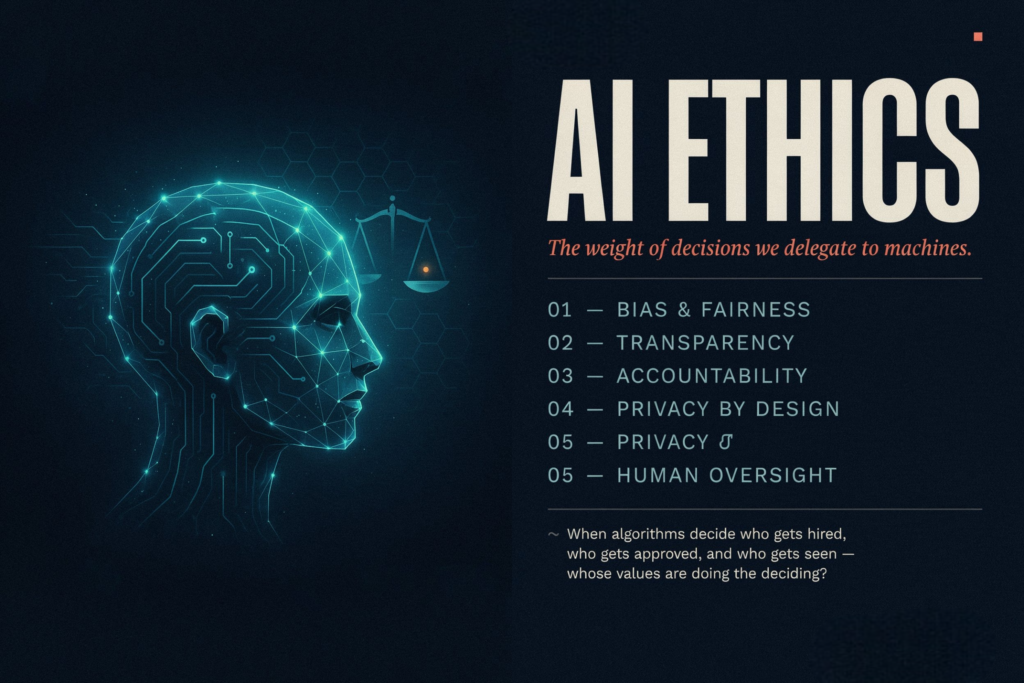
Let’s get the definition out of the way, plainly. AI ethics is the set of principles, practices, and accountability structures that govern how artificial intelligence gets built, trained, deployed, and monitored so that it helps people instead of quietly harming them.
That’s it. No jargon needed. AI ethics and governance isn’t a philosophy seminar. It’s risk management with a moral backbone.
Artificial intelligence ethics 2026 looks different than it did even two years back, mostly because the technology moved faster than most companies’ policies did. Generative AI ethics and agentic AI ethics are now front and center, because the tools aren’t just answering questions anymore they’re booking appointments, approving claims, screening resumes, and making judgment calls that used to require a human in the room.
The relationship between ai and ethics, or ethics of ai if you prefer the academic phrasing, used to be a debate confined to research papers. Ethical AI considerations now show up in procurement contracts, board meetings, and customer complaint forms.
Ethical AI in 2026 means asking one blunt question before any of that automation goes live: if this system makes a mistake, who notices, who’s accountable, and who gets hurt?
A few things changed the math.
First, agentic AI ethics became a real conversation instead of a research-paper topic. Autonomous AI agents that can take multi-step actions booking, purchasing, modifying records, sending communications without a human checking every step are now common in customer service, finance, and operations. Human oversight in AI used to mean someone reviewing a chatbot transcript. Now it means deciding how much independence an AI agent should have before a human needs to sign off.
Second, AI regulation 2026 stopped being abstract. The EU AI Act 2026 enforcement phase is active, and high-risk AI systems operating in or selling into the EU face real obligations documentation, human oversight, risk assessments, and the works. American companies doing business internationally don’t get to ignore this just because they’re headquartered in Ohio or Texas.
Third, generative AI ethics moved from “is this text biased” to “is this text even real.” AI hallucinations, synthetic media, and deepfake ethics are now boardroom topics, not just AI safety conference panels. A retailer in Denver, Colorado had a customer service chatbot confidently invent a return policy that didn’t exist. The customer recorded the exchange. It went semi-viral on a local subreddit before anyone at the company even knew there was a problem.
If you strip away the consulting-deck language, ethical AI development rests on a short list of AI ethics principles that show up across nearly every serious framework — IBM’s, NIST’s, the OECD’s, UNESCO’s. Responsible AI 2026 and ethical artificial intelligence aren’t separate movements; they’re the same goal described by different vendors. Digital ethics and algorithmic ethics are the broader umbrella terms academics use, but the practical list of ethical issues in artificial intelligence narrows down fast once you’re actually building something.
Fairness. AI fairness means an algorithmic system treats people equitably regardless of race, gender, age, disability, or zip code. Algorithmic bias creeps in through biased training data, dataset bias, and design choices nobody flagged as risky at the time. Renee’s recruiting tool wasn’t fair. It was efficient at being unfair, which is worse.
Explainable AI. AI explainability means a human can actually understand why a model made a specific decision. Black-box AI models that spit out outputs nobody can trace back to a reason is a liability, not a feature. If a loan gets denied, a claim gets rejected, or a candidate gets screened out, someone needs to be able to explain why in terms a person, not a data scientist, can follow.
Transparency and traceability. Transparent algorithms and AI decision transparency mean documenting what data trained a model, what its limitations are, and how its outputs get used downstream. Traceability is what lets an AI audit actually mean something instead of being a rubber stamp.
Accountability. AI accountability and algorithmic accountability mean a specific person or team owns the outcome of an AI system not “the algorithm did it,” full stop. Independent AI oversight, whether that’s an internal ethics board or external auditor, is what makes accountability more than a slogan.
Robustness and AI safety and security. Trustworthy AI systems need to hold up against adversarial manipulation, data poisoning, and plain old technical failure. Model security and AI safety and security aren’t optional extras bolted on after launch.
Privacy. AI privacy concerns and AI data protection sit at the center of nearly every modern framework, because almost every AI system runs on personal data whether anyone meant it to or not.
These six ai ethics principles aren’t new ideas dressed up for 2026. What’s new is how seriously regulators, customers, and courts are starting to enforce them. AI bias and discrimination and algorithmic discrimination remain the most litigated category, while AI transparency and explainability is quickly becoming the most regulated.
Here’s something that doesn’t get said plainly enough: most companies don’t intend to build biased AI. Discrimination in AI usually isn’t malicious. It’s lazy.
Biased training data happens when a dataset reflects historical inequality and the model learns to repeat it. Amazon’s scrapped recruiting tool from a few years back is the textbook case trained mostly on resumes from men, it learned to downgrade resumes that mentioned women’s colleges or women’s sports teams. Nobody coded “penalize women” into that system. The data did the coding.
Equal treatment and representational harm matter beyond hiring, too. Facial recognition tools have a well-documented history of struggling to identify people with darker skin tones accurately. Biometric recognition deployed in retail, banking, or law enforcement settings without rigorous bias detection isn’t innovation, it’s exposure.
Fairness testing and bias detection need to happen before deployment, not after a lawsuit. That means auditing training data for skew, testing outputs across demographic groups, and being honest when a model fails that test instead of shipping it anyway because the deadline already slipped twice.
A bank in Charlotte, North Carolina ran exactly this kind of audit on its loan-approval model last year and found it was approving smaller credit limits for applicants in two specific neighborhoods not because of income or credit history, but because of a zip-code proxy buried three layers deep in the feature set. They caught it before launch. That’s the difference between ethical AI development and an expensive correction six months later.
Why is explainability important in artificial intelligence? Because “trust me” isn’t a legal defense and it isn’t a business strategy.
AI explainability is the ability to answer, in plain language, why a model produced a specific output. Black-box AI deep learning systems whose internal logic is mathematically real but humanly incomprehensible, creates a structural problem: you can’t fix what you can’t explain, and you can’t defend what you can’t explain either.
An AI impact assessment is the practical tool here. Before deployment, teams document what the system does, what data it uses, what could go wrong, and who’s affected if it does. Model documentation isn’t busywork. It’s the paper trail that makes an AI audit possible six months or two years later when someone asks, “why did the system do that?”
Algorithmic accountability requires this kind of traceability built in from day one. Retrofitting explainability onto a model that’s already been running in production for a year is far harder and far more expensive than designing for it from the start.
AI data protection sits at the intersection of two pressures: companies want AI systems trained on rich, specific data, and customers want their personal data left alone.
Personal data and AI don’t mix easily. Generative AI tools that ingest customer support transcripts, internal documents, or healthcare records for training raise real AI privacy concerns if consent and data minimization aren’t built into the process. Data consent has to mean something more than a checkbox buried in page nine of a terms-of-service document nobody reads.
AI surveillance is its own category of concern. Biometric recognition, workplace monitoring tools, and location-tracking features built into apps can slide from “useful feature” into “surveillance” faster than most product teams notice. Workplace surveillance through AI-powered monitoring software has triggered employee backlash and, in some states, new legislation specifically targeting it.
Cybersecurity risks compound the privacy problem. Model security failures: a poisoned dataset, a leaked model, an exposed API can turn an AI privacy gap into a full data breach. Confidential information fed into a generative AI tool by an employee who didn’t realize the tool retains and trains on that input is one of the most common, least-discussed AI ethics issues inside companies right now.
Large language model ethics and LLM bias get most of the headlines, but AI hallucinations are the more immediate operational risk for most businesses. A model confidently generating false information, a fake return policy, a fabricated statistic, a legal citation that doesn’t exist isn’t a bug anymore. It’s an expected behavior that needs a mitigation plan. Left unchecked, AI hallucinations turn into AI-generated misinformation at scale, spreading through customer chats, marketing copy, and internal reports faster than anyone can fact-check them.
AI-generated content disclosure is becoming standard practice for a reason. If a customer is talking to an AI agent, reading AI-generated marketing copy, or looking at a product image touched by generative tools, disclosure builds the kind of trust that silence erodes.
Synthetic media and deepfake ethics raise sharper concerns. Content provenance tools and standards that let people verify whether an image, video, or audio clip is AI-generated are moving from “nice to have” to “expected” as fast as the underlying generative tools improve. A marketing agency in Raleigh, North Carolina now runs every AI-generated visual through a provenance check before it goes anywhere near a client campaign, specifically because one unlabeled AI-generated image caused a minor credibility problem with a client last year.
Agentic AI ethics deserves its own section because autonomous AI agents are the fastest-growing category of AI risk right now. An agent that can read an email, decide a customer is owed a refund, and issue that refund without a human reviewing the decision is efficient right up until it’s wrong.
Human-in-the-loop AI design means building a checkpoint into the workflow before high-stakes or high-cost actions execute. Not every action needs a human gate. A chatbot answering a shipping-status question doesn’t need a supervisor. An autonomous agent approving a $4,000 refund probably does.
AI model alignment making sure an agent’s behavior actually matches the intent behind it gets harder as agents get more autonomous and more capable. Frontier AI safety research is grappling with this at the largest scale, but the same principle applies to a mid-size company in Phoenix, Arizona deploying its first AI agent for accounts payable. Alignment isn’t just a research lab problem. It’s a Tuesday-morning operations problem.
AI risk management for agentic systems means defining, in writing, what an agent is allowed to do alone and what requires sign-off before the agent is live, not after it does something nobody approved.
Innovation in AI moves faster than regulation almost everywhere. AI legislation is catching up, though, and 2026 is the year a lot of it stopped being optional. Global AI regulation is still fragmented; no single AI policy framework governs every market which means companies operating across borders need to track several rulebooks at once, not just one.
EU Artificial Intelligence Act. The EU AI Act 2026 phase brings binding obligations for high-risk AI systems documentation, transparency, human oversight, and risk classification requirements. Any U.S. company selling software or services into the EU market needs a compliance plan, not a hope that nobody notices.
NIST AI RMF. The NIST AI Risk Management Framework gives U.S. organizations a structured, voluntary-but-increasingly-expected approach to identifying and managing AI risk across the system lifecycle. Federal contractors and NIST-aligned businesses are treating this as close to mandatory in practice, even where it isn’t mandatory in law.
OECD AI Principles and UNESCO AI ethics guidance shape how global frameworks talk about human-centered AI, even where they aren’t directly enforceable in U.S. courts. Human rights and AI sit at the core of both bodies’ work. The underlying concern is that automated systems shouldn’t be allowed to erode protections that took decades to establish. They influence how American regulators and industry groups draft their own rules.
State-level activity. Risk-based AI regulation is showing up state by state. Colorado passed one of the first comprehensive state AI laws targeting high-risk automated decision systems. California has been finalizing rules on automated decision-making technology, with compliance deadlines that businesses operating in the state need to track closely. Illinois and New York have both moved on AI-specific employment and biometric rules. A business with employees or customers spread across California, Colorado, Illinois, Texas, and New York can’t comply with one AI policy. It needs to track several, and the list keeps growing.
AI compliance in 2026 increasingly means treating AI governance the way companies already treat data privacy compliance as a standing operational function, not a one-time legal review.
A real AI governance board does more than approve a values statement once a year. Responsible AI policies need actual review processes, actual sign-off requirements, actual consequences when a team skips the process.
A working AI governance framework typically includes:
Some jurisdictions are experimenting with an AI regulatory sandbox model, letting companies test new AI applications under regulatory supervision before full rules apply. It’s an imperfect tool, but it beats the alternative of zero guidance until something breaks. AI standards from bodies like NIST and ISO are filling in the technical detail that broader AI legislation leaves out, and responsible innovation increasingly means building to those standards voluntarily, ahead of any mandate, rather than waiting to be told.
Generative AI governance specifically needs guardrails around what data feeds these tools, what outputs get published without review, and how AI-generated content disclosure gets handled across marketing, customer service, and internal communications.
AI in healthcare ethics carries the highest stakes of any sector. Diagnostic AI, treatment recommendation tools, and administrative AI in hospitals all touch human lives directly. Bias in a healthcare AI model isn’t an inconvenience, it’s a patient safety issue. A hospital system in Nashville, Tennessee now requires a clinical-equity review for any AI diagnostic tool before it touches a single patient chart.
AI in finance ethics covers credit decisions, fraud detection, and algorithmic trading. Discrimination in AI-driven lending decisions is already drawing regulatory attention, and AI fairness in this sector isn’t a competitive advantage; it’s table stakes for staying out of court.
AI in education ethics raises questions about automated grading, plagiarism detection that misfires on non-native English speakers, and AI tutoring systems that need to serve students fairly regardless of background.
AI job displacement and AI and employment concerns are real, but the more immediate ethical issue for most companies right now is automated hiring bias screening tools, like Renee’s, that quietly filter out qualified candidates based on proxies for protected characteristics. Workplace surveillance through AI monitoring tools adds a second layer of employee-facing ethical risk that HR and legal teams are only now catching up to.
AI copyright issues and intellectual property and AI questions are unsettled in U.S. courts as generative AI models trained on copyrighted material face ongoing litigation. Companies using generative AI for content, code, or design need a clear policy on what’s safe to use and what carries legal risk.
AI environmental impact and AI energy consumption are becoming boardroom topics too, especially for companies running large models at scale. Digital inequality, who gets access to AI’s benefits and who gets left behind rounds out the social impact of AI conversation that inclusive AI and AI for social good initiatives are trying to address. AI and democratic values come into play too, particularly when automated systems influence what information people see or how civic services get delivered. Ethical decision-making, at the end of the day, is still a human responsibility. AI can inform a decision, but it shouldn’t be left to make the final call alone on anything that affects someone’s rights or livelihood.
Most AI ethics failures aren’t philosophical. They’re architectural. A biased outcome usually traces back to a dataset nobody audited, a model nobody explained, or an agent given more autonomy than anyone meant to grant it.
That’s the layer where it actually gets fixed — not in a values statement, but in the build. Our AI development services bake fairness testing, explainability requirements, and human-in-the-loop checkpoints into AI systems from the design phase, not as an afterthought bolted on after a complaint.
Companies building customer-facing generative AI tools work with our team to get AI chatbot development right — including AI-generated content disclosure, hallucination mitigation, and escalation paths to human agents when a conversation needs one. For businesses running call center automation, ethical AI design means making sure automated systems know when to hand a sensitive conversation to a person instead of pushing a script.
Our software development and custom CRM development teams build data handling and AI privacy protections directly into system architecture — not as a compliance patch applied after a system already went live. And for companies needing to scale AI governance expertise fast without a six-month hiring cycle, our staff augmentation services bring in development talent that already understands what responsible AI development requires, particularly useful for growing tech companies in states like Washington, Colorado, and Virginia building out their first formal AI governance function.
If your AI roadmap needs an ethics and governance review before launch not after a problem surfaces — reach out and let’s talk.
Skip the generic version. Here’s what actually needs to be true before an AI system goes live:
If any answer is “we haven’t checked,” that’s the next task. Not next quarter. Now.
Renee’s recruiting tool taught her something a lot of business owners are learning the hard way this year: AI doesn’t need bad intentions to cause real harm. It just needs an unchecked dataset, an unexplained decision, and nobody asking the right question before launch.
AI ethics in 2026 isn’t about slowing innovation down. It’s about building systems that hold up to scrutiny, to regulation, to the people they affect so a company doesn’t find out the hard way, the way Renee did, that efficient and ethical aren’t automatically the same thing. Ethical use of AI and ethical technology aren’t competing priorities against growth; they’re what makes growth sustainable instead of one bad headline away from collapsing.
The future of AI ethics belongs to companies that build accountability from the start, not the ones bolting it on after the headline.
Q1: What is AI ethics in 2026?
AI ethics in 2026 means building, deploying, and monitoring AI systems with fairness, transparency, accountability, and privacy as core requirements, not afterthoughts.
Q2: What are the main principles of AI ethics?
Fairness, explainability, transparency, accountability, robustness, and privacy form the core ai ethics principles most frameworks, including IBM’s and NIST’s, rely on.
Q3: How does bias enter an AI system?
Bias usually enters through biased training data that reflects historical inequality, which the model then learns and repeats in its decisions and outputs.
Q4: What is the difference between AI ethics and AI governance?
AI ethics defines the principles; AI governance is the operational structure — policies, reviews, ownership, and oversight — that enforces those principles in practice.
Q5: What AI laws take effect in 2026?
The EU AI Act’s enforcement phase, NIST AI RMF adoption, and new state laws in Colorado and California are the key AI regulations active in 2026.